Advertisements
Advertisements
प्रश्न
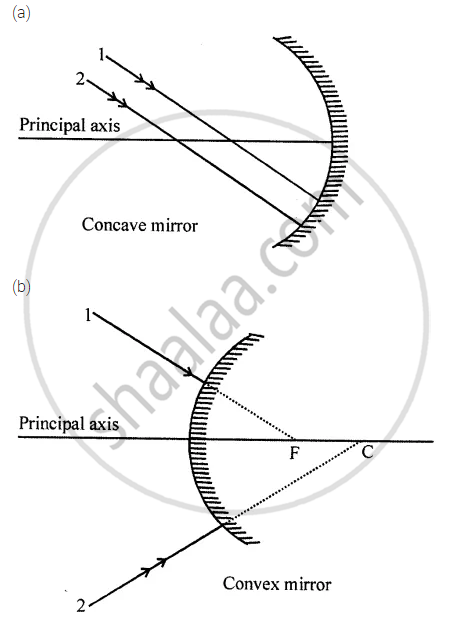
Complete the following diagrams in figure by drawing the reflected rays for the incident rays 1 and 2 if F is the focus and C is the centre of curvature.
Advertisements
उत्तर

1. Ray passing through F after reflection becomes parallel to the principal axis.
Ray (2) passing through the centre of curvature travels back (retraces its path) i.e. reflected back along its own path.

APPEARS IN
संबंधित प्रश्न
Draw a ray diagram to show the path of the reflected ray corresponding to an incident ray of light parallel to the principal axis of a convex mirror and show the angle of incidence and angle of reflection on it.
The image formed by a concave mirror is observed to be virtual, erect and larger than the object. Where should the position of the object be relative to the mirror? Draw ray diagram to justify your answer.
A spherical mirror produces an image of magnification −1 on a screen placed at a distance of 40 cm from the mirror:
(i) Write the type of mirror.
(ii) What is the nature of the image formed?
(iii) How far is the object located from the mirror?
(iv) Draw the ray diagram to show the image formation in this case.
A concave mirror produces three times magnified image on a screen. If the object is placed 20 cm in front of the mirror, how far is the screen from the object.
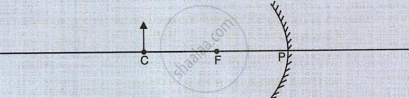
Draw the following diagram in your answer book and show the formation of image with the help of suitable rays:
If a concave mirror has a focal length of 10 cm, find the two positions where an object can be placed to give, in each case, an image twice the height of the object.
List four characteristics of the image formed by a concave mirror of focal length 40 cm when the object is placed in front of it at a distance of 20 cm from its pole.
Match the following.
| Convex mirror | Radio telescopes |
| Parobolic mirror | Rear – view mirror |
| Snell’s law | Kaleidoscope |
| Dispersion of light | sin i/sin r =μ |
| Refractive index | Rainbow |
A child is standing in front of a magic mirror. She finds the image of her head bigger, the middle portion of her body of the same size and that of the legs smaller. The following is the order of combinations for the magic mirror from the top.
State whether the following statement is True or False.
The sides of an object and its image formed by a concave mirror are always interchanged
