Advertisements
Advertisements
Question
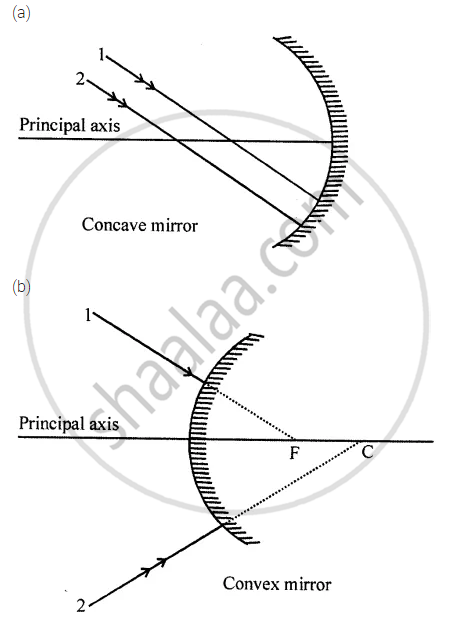
Complete the following diagrams in figure by drawing the reflected rays for the incident rays 1 and 2 if F is the focus and C is the centre of curvature.
Advertisements
Solution

1. Ray passing through F after reflection becomes parallel to the principal axis.
Ray (2) passing through the centre of curvature travels back (retraces its path) i.e. reflected back along its own path.

APPEARS IN
RELATED QUESTIONS
Draw ray diagrams to show the principal focus of a concave mirror.
A student has obtained the image of a distant object with a concave mirror to determine its focal length. If he has selected a well-illuminated red building as object, which of the following correctly describes the features of the image formed?
(A) Virtual, inverted and diminished image in red shade
(B) Real, erect and diminished image in pink shade
(C) Real, inverted and diminished image in red shade
(D) Virtual, erect and enlarged image in red shade
For a convex mirror, parallel rays of light appear to diverge from a point called the ______.
State where an object must be placed so that the image formed by a concave mirror is:
(b) at infinity.
(c) the same size as the object.
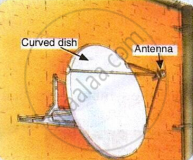
The diagram shows a dish antenna which is used to receive television signals from a satellite. The antenna (signal detector) is fixed in front of the curved dish.
- What is the purpose of the dish?
- Should it be concave or convex?
- Where should the antenna be positioned to receive the strongest possible signals?
- Explain what change you would expect in the signals if a larger dish was used.
An object is placed 15 cm from (a) a converging mirror, and (b) a diverging mirror, of radius of curvature 20 cm. Calculate the image position and magnification in each case.
Draw the ray diagram and also state the position, the relative size and the nature of image formed by a concave mirror when the object is placed at the centre of curvature of the mirror.
Answer the following question:
An object is placed at a distance of 30 cm from a concave lens of focal length 30 cm.
(i) Use the lens formula to determine the distance of the image from the lens.
(ii) List four characteristics of the image (nature, position, size, erect/inverted) in this case.
(iii) Draw a labelled diagram to justify your answer of the part (ii)
According to cartesion sign convention, which mirror and which lens has negative focal length?
The focal length of a concave mirror is 5cm. Its radius of curvature is ______.
