Advertisements
Advertisements
Question
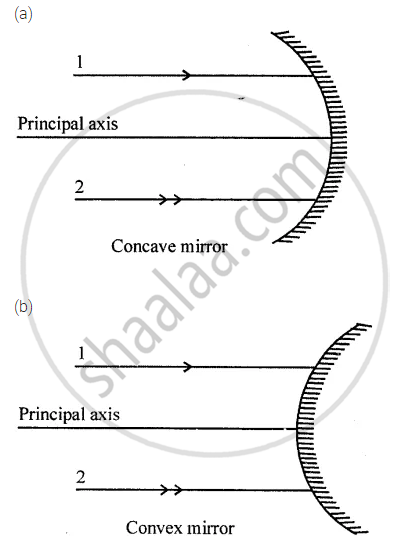
The diagram (figure) given below shows two parallel rays 1 and 2 incident on (a) a concave mirror, (b) a convex mirror. Draw the reflected rays and mark the focus by the symbol F.
Advertisements
Solution

APPEARS IN
RELATED QUESTIONS
Name the phenomenon responsible for the following effect:
When we sit in front of a plane mirror and write with our right hand, it appears in the mirror that we are writing with the left hand.
State the uses of plane mirrors.
Which phenomenon of light makes the water to appear shallower than it really is?
A vertical ray of light strikes the horizontal surface of some water:
What is the angle of refraction?
The speed of light is more in glass than in water.
A real image is formed by the light rays after reflection or refraction when they:
- actually meet or intersect with each other.
- actually converge at a point.
- appear to meet when they are produced in the backward direction.
- appear to diverge from a point.
Which of the above statements are correct?
Why does a ray of light bend when it travels from one medium to another?
The deviation of light ray from its path when it travels from one transparent medium to another transparent medium is called ______.
When a ray of light travels normal to the given surface, then the angle of refraction is ______.
Which of the following relations is called Snell's Law?
