Advertisements
Advertisements
Question
With the help of a labelled diagram, explain why a tank full of water appears less deep than it actually is.
Advertisements
Solution
Refraction of light causes a tank full of water to appear less deep than it actually is.
Suppose, we have a tank of water as shown in the following figure.
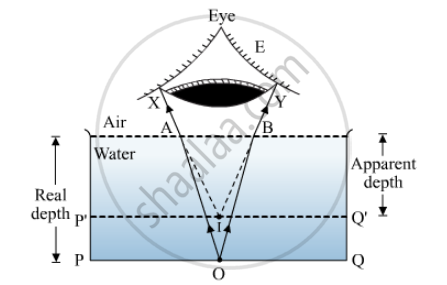
Here, we take a point O at the bottom of the tank. We see this point because of the light rays coming from it. Now, a light ray OA from point O passes through water and enters air at point A. It gets refracted away from the normal in the direction AX. Similarly, another ray OB gets refracted at point B and bends away from the normal in the direction BY. These two refracted rays, i.e., AX and BY, meet at point I on producing them backwards. This point I (nearer to the water surface than O) is the image of point O.
Therefore, point O appears to be nearer at position I. Similarly, this can be applied to all points on the bottom of the tank. This causes the tank to appear less deep than it actually is.
APPEARS IN
RELATED QUESTIONS
If an object is placed at a distance of 10 cm in from of a plane mirror, how far would it be from its image?
Write the word AMBULANCE as it would appear when reflected in a plane mirror. Why is it sometimes written in this way (as its mirror image) on the front of an ambulance?
What type of reflection of light takes place from a cinema screen?
A ray of light strikes a plane mirror PQ at an angle of incidence of 30°, is reflected from the plane mirror and then strikes a second plane mirror QR placed at right angles to the first mirror. The angle of reflection at the second mirror is ______.
As light rays pass from water into glass, are they refracted towards the normal or away from the normal?
Show the lateral displacement of the ray on the diagram.
Water is optically .......... than air.
Match the Following
| Column A | Column B |
| (a) white Light | (1) Convex mirror |
| (b) Refraction | (2) Concave mirror |
| (c) Virtual images | (3) refraction |
| (d) Real images | (4) spectrum |
| (e) Prism | (5) ray of light from glass to air |
The phenomenon of change in the direction of light when it passes from one transparent medium to another is called ___________.
Noor, a young student, was trying to demonstrate some properties of light in her Science project work. She kept ‘X’ inside the box (as shown in the figure) and with the help of a laser pointer made light rays pass through the holes on one side of the box. She had a small butter-paper screen to see the spots of light being cast as they emerged.

Her friend noted the following observations from this demonstration:
- Glass is optically rarer than air.
- Air and glass allow light to pass through them with the same velocity.
- Air is optically rarer than glass.
- Speed of light through a denser medium is faster than that of a rarer medium.
- The ratio: sin of angle of incidence in the first medium to the ratio of sin of angle of refraction in the second medium, gives the refractive index of the second material with respect to the first one.
Which one of the combinations of the above statements given below is correct.
A pencil when dipped in water in a glass tumbler appears to be bent at the interface of air and water. Will the pencil appear to be bent to the same extent, if instead of water we use liquids like, kerosene or turpentine. Support your answer with reason.
Which object use the reflection of light?
Light is refracted or bent while going from one medium to another because of its ______ changes.
When a ray of light travels normal to the given surface, then the angle of refraction is ______.
The change in the direction of the path of light when it passes from one transparent medium to another transparent medium is called:
The ray that enters the second medium after crossing the boundary is called the:
A normal is an imaginary line drawn ________ to the boundary at the point of incidence.
When a light ray passes from a denser medium to a rarer medium, it bends:
A larger refractive index of a medium means that light travels:
