Advertisements
Advertisements
प्रश्न
With the help of a labelled diagram, explain why a tank full of water appears less deep than it actually is.
Advertisements
उत्तर
Refraction of light causes a tank full of water to appear less deep than it actually is.
Suppose, we have a tank of water as shown in the following figure.
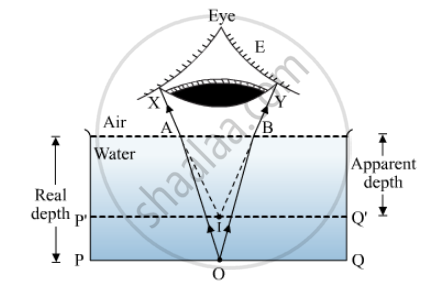
Here, we take a point O at the bottom of the tank. We see this point because of the light rays coming from it. Now, a light ray OA from point O passes through water and enters air at point A. It gets refracted away from the normal in the direction AX. Similarly, another ray OB gets refracted at point B and bends away from the normal in the direction BY. These two refracted rays, i.e., AX and BY, meet at point I on producing them backwards. This point I (nearer to the water surface than O) is the image of point O.
Therefore, point O appears to be nearer at position I. Similarly, this can be applied to all points on the bottom of the tank. This causes the tank to appear less deep than it actually is.
APPEARS IN
संबंधित प्रश्न
Which property of light makes a pencil cast a shadow when it is held in front of a light source?
Write the word AMBULANCE as it would appear when reflected in a plane mirror. Why is it sometimes written in this way (as its mirror image) on the front of an ambulance?
The image in a plane mirror is virtual and laterally inverted. What does this statement mean?
What is meant by ‘refraction of light’?
Show the lateral displacement of the ray on the diagram.
Air is optically .......... than glass.
A ray of light passes from medium 1 to medium 2. Which of the following quantities of the refracted ray will differ from that of the incident ray: Speed, intensity, frequency, wavelength?
The size of image of an object by a convex lens of focal length 20 cm is observed to be reduced to `1/3` rd of its size . Find the distance of the object from the optical centre of the lens .
A real image is formed by the light rays after reflection or refraction when they:
- actually meet or intersect with each other.
- actually converge at a point.
- appear to meet when they are produced in the backward direction.
- appear to diverge from a point.
Which of the above statements are correct?
The laws of reflection hold true for ______.
Observe the given figure and name the following.
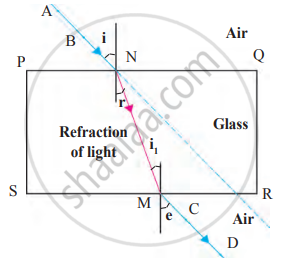
| Ray AB | |
| Ray NM | |
| Ray MD | |
| ∠ r |
State whether true or false. If false, correct the statement.
The angle of deviation depends on the refractive index of the glass.
Why does a ray of light bend when it travels from one medium to another?
Explain with diagrams how refraction of incident light takes place from
- rarer to denser medium
- denser to rarer medium
- normal to the surface separating the two media.
The angle of incidence for a ray of light having zero reflection angle is ______.
A pencil when dipped in water in a glass tumbler appears to be bent at the interface of air and water. Will the pencil appear to be bent to the same extent, if instead of water we use liquids like, kerosene or turpentine. Support your answer with reason.
Match the following:
| Column I | Column II | ||
| 1. | r > 90 | a. | Light gazes at the surface of separation between the two modes. |
| 2. | r = 90 | b. | No refraction. |
| 3. | r < 90 | c. | Refracted ray away from the normal |
The part of light that enters into the other medium and travels in a straight path but in a direction different from its initial direction is called:
According to the first law of refraction, the incident ray, the refracted ray, and the normal at the point of incidence:
To a crane, a fish appears 6 cm below the water surface. Taking the refractive index of water as \[\frac{4}{3}\], the real depth of the fish below the surface is:
