Advertisements
Advertisements
Question
Match the Following
| Column A | Column B |
| (a) white Light | (1) Convex mirror |
| (b) Refraction | (2) Concave mirror |
| (c) Virtual images | (3) refraction |
| (d) Real images | (4) spectrum |
| (e) Prism | (5) ray of light from glass to air |
Advertisements
Solution
| Column A | Column B |
| (a) White light | (1) Spectrum |
| (b) Refraction | (2) Ray of light from glass to air |
| (c) Virtual images | (3) Convex mirror |
| (d) Real images | (4) Concave mirror |
| (e) Prism | (5) refraction |
APPEARS IN
RELATED QUESTIONS
Which property of light makes a pencil cast a shadow when it is held in front of a light source?
A wall reflects light and a mirror also reflects light. What difference is three in the way they reflect light?
An extended object in the form of an arrow pointing upward has been placed in front of a plane mirror. Draw a labelled ray-diagram to show the formation of its image.
State the uses of plane mirrors.
What is the cause of refraction of light when it passes from one medium to another?
The phenomenon of change in the direction of light when it passes from one transparent medium to another is called ___________.
The angle of incidence for a ray of light having zero reflection angle is ______.
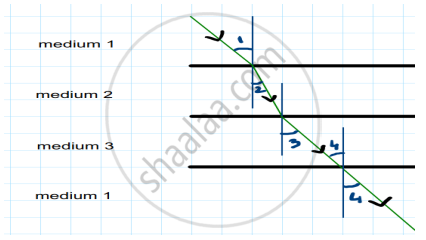
In the above diagram light is travelling through different media. It is noted by a scientist that ∠1= ∠3 = ∠4 but ∠2 < ∠1. Which of the following statement would be correct?
Light bends as it passes from one medium to another. What is this phenomenon called?
According to the second law of refraction, for a given pair of media, the ratio of the sine of the angle of incidence to the sine of the angle of refraction:
