Advertisements
Advertisements
Question
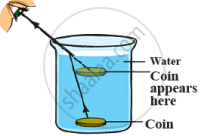
Which phenomenon of light makes the water to appear shallower than it really is?
Advertisements
Solution
Refraction of light causes the water to appear shallower than it really is.
APPEARS IN
RELATED QUESTIONS
What is refraction of light?
Where is the image when you look at something in a mirror?
A wall reflects light and a mirror also reflects light. What difference is three in the way they reflect light?
The boy walks towards the mirror at a speed of 1 m/s. At what speed does his image approach him?
A man sits in an optician's chair looking into plane mirror which is 2 m away from him and views the image of a chart which faces the mirror and is 50 cm behind his head. How far away from his eyes does the chart appear to be?
A ray of light travelling in glass emerges into air. State whether it will bend towards the normal or away from the normal.
When a ray of light passes from air into glass, is the angle of refraction greater than or less than the angle of incidence?
Fill in the following blank with suitable word:
Light travelling along a normal is ...............refracted.
Fill in the following blank with suitable word:
Light bends when is passes from water into air. We say that it is ............
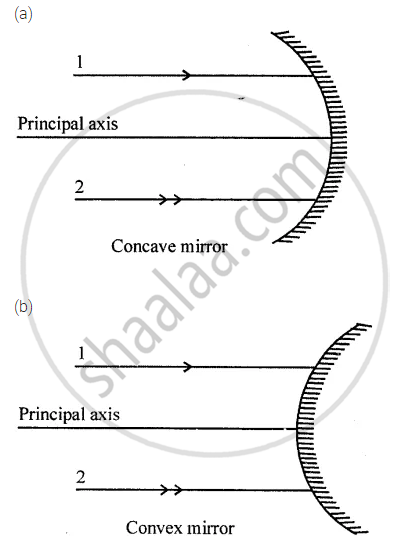
The diagram (figure) given below shows two parallel rays 1 and 2 incident on (a) a concave mirror, (b) a convex mirror. Draw the reflected rays and mark the focus by the symbol F.
A ray of light passes from medium 1 to medium 2. Which of the following quantities of the refracted ray will differ from that of the incident ray: Speed, intensity, frequency, wavelength?
Fill in the blank and Explain the completed sentences.
The change in ______ of light rays while going from one medium to another is called refraction.
List in proper sequence the steps of the experiment for determining the approximate focal length of a given concave mirror by obtaining the image of a distant object.
Observe the given figure and name the following.
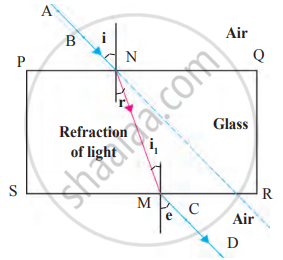
| Ray AB | |
| Ray NM | |
| Ray MD | |
| ∠ r |
Observe the given figure and write appropriate phenomenon of light in the box.
What is refractive index?
If a beam of red light and a beam of violet light are incident at the same angle on the inclined surface of a prism from air medium and produce angles of refraction r and v respectively, which of the following is correct?
A ray of light traveling in medium 1 strikes and travels into another transparent medium 2. If the speed of light is greater in medium 1, the ray will ______.
Match the following:
| Column I | Column II | ||
| 1. | r > 90 | a. | Light gazes at the surface of separation between the two modes. |
| 2. | r = 90 | b. | No refraction. |
| 3. | r < 90 | c. | Refracted ray away from the normal |
In refraction of light through a glass slab, the directions of the incident ray and the refracted ray are ______.
