Advertisements
Advertisements
Question
A man stands 10 m in front of a large plane mirror. How far must the walk before he is 5 m away from his image?
Advertisements
Solution
Man should walk 7.5 m towards the mirror.
The reason being, the image formed by a plane mirror is the same distance behind the mirror as it is between the object and the mirror. A distance of 5m between man and his image means that the distance between him and the mirror = `52`= 2.5 m.
Thus, the distance he should walk = 10 - 2.5 = 7.5 m.
APPEARS IN
RELATED QUESTIONS
What is refraction of light?
Write the word AMBULANCE as it would appear when reflected in a plane mirror. Why is it sometimes written in this way (as its mirror image) on the front of an ambulance?
State the uses of plane mirrors.
Write all the capital letters of the alphabet which look the same in a plane mirror.
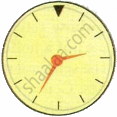
The figure given alongside shows the image of a clock as seen in a plane mirror. The correct time is:
State two effects caused by the refraction of light.
When a ray of light passes from air into glass, is the angle of refraction greater than or less than the angle of incidence?
A coin in a glass tumbler appears to rise as the glass tumbler is slowly filled with water. Name the phenomenon responsible for this effect.
A ray of light passes from a medium X to another medium Y. No refraction of light occurs if the ray of light hits the boundary of medium Y at an angle of:
(a) 0°
(b) 45°
(c) 90°
(d) 120°
Match the Following
| Column A | Column B |
| (a) white Light | (1) Convex mirror |
| (b) Refraction | (2) Concave mirror |
| (c) Virtual images | (3) refraction |
| (d) Real images | (4) spectrum |
| (e) Prism | (5) ray of light from glass to air |
What do you understand by refraction of light?
The size of image of an object by a convex lens of focal length 20 cm is observed to be reduced to `1/3` rd of its size . Find the distance of the object from the optical centre of the lens .
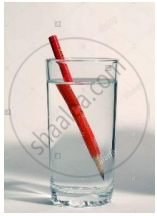
Due to _______ pencil looks bent in water, in the given experiment.
Write scientific reason.
The sun appears on the western horizon for some time after sunset.
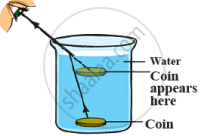
Observe the given figure and write appropriate phenomenon of light in the box.
If a beam of red light and a beam of violet light are incident at the same angle on the inclined surface of a prism from air medium and produce angles of refraction r and v respectively, which of the following is correct?
Light is refracted or bent while going from one medium to another because of its ______ changes.
Under what circumstances there won’t be any refraction of light when it enters from one medium to another?
When light travels from a denser medium to a rarer medium, its speed:
According to the first law of refraction, the incident ray, the refracted ray, and the normal at the point of incidence:
