Advertisements
Advertisements
Question
An object is placed 20 cm in front of a plane mirror. The mirror is moved 2 cm towards the object. The distance between the positions of the positions of the original and final images seen in the mirror is ______.
Options
2 cm
4 cm
10 cm
22 cm
Advertisements
Solution
An object is placed 20 cm in front of a plane mirror. The mirror is moved 2 cm towards the object. The distance between the positions of the positions of the original and final images seen in the mirror is 4 cm.
APPEARS IN
RELATED QUESTIONS
State and explain the laws of reflection of light at a plane surface (like a plane mirror), With the help of a labelled ray-diagram. Mark the angles of 'incidence' and 'reflection' clearly on the diagram. If the angle of reflection is 47.5°, what will be the angle of incidence?
Explain how to read the following message which was found on some blotting paper:

When a ray of light passes from air into glass, is the angle of refraction greater than or less than the angle of incidence?
A ray of light passes from air into a block of glass. Does it bend towards the normal or away from it?
Show the lateral displacement of the ray on the diagram.
Explain with the help of a labelled ray diagram, why a pencil partly immersed in water appears to be bent at the water surface. State whether the bending of pencil will increase or decrease if water is replaced by another liquid which is optically more dense than water. Give reason for your answer.
Light travelling from a denser medium to a rarer medium along a normal to the boundary:
(a) is refracted towards the normal
(b) is refracted away from the normal
(c) goes along the boundary
(d) is not refracted
The depth of a pond when seen from above appears to be less.
A ray of light A incident from air suffers partial reflection and refraction at the boundary of water.
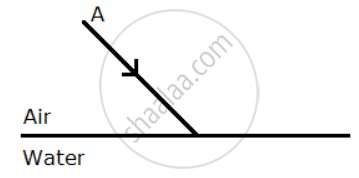
- Complete the diagram showing (i) the reflected ray B and (ii) the refracted ray C.
- How are the angles of incidence i and refraction r related?
List four characteristics of the image formed by a concave lens of focal length 20 cm when the object is placed at a distance of 40 cm from its optical centre.
The phenomenon of change in the direction of light when it passes from one transparent medium to another is called ___________.
Explain how the formation of a rainbow occurs.
The angle of incidence for a ray of light having zero reflection angle is ______.
A ray of light traveling in medium 1 strikes and travels into another transparent medium 2. If the speed of light is greater in medium 1, the ray will ______.
Why a pencil partly immersed in water appears to be bent at the water surface.
The absolute refractive index of a medium is given by:
In the formula for absolute refractive index \[n = \frac{c}{v}\], the quantity c represents:
To a crane, a fish appears 6 cm below the water surface. Taking the refractive index of water as \[\frac{4}{3}\], the real depth of the fish below the surface is:
