Advertisements
Advertisements
Question
A man sits in an optician's chair looking into plane mirror which is 2 m away from him and views the image of a chart which faces the mirror and is 50 cm behind his head. How far away from his eyes does the chart appear to be?
Advertisements
Solution
he image of the chart will appear 4.5 m away from the eye.
The image of the chart will form at a distance of 2 m + 0.5m = 2.5 m behind the mirror. The reason being, the image formed by a plane mirror is at the same distance behind it as it is between the object and the mirror.
Thus,
distance of the chart's image from the eye = distance of man from the mirror + distance of image formed behind the mirror = 2 + 2.5 = 4m.
APPEARS IN
RELATED QUESTIONS
What is refraction of light?
What is lateral inversion? Explain by giving a suitable example.
A wall reflects light and a mirror also reflects light. What difference is three in the way they reflect light?
An extended object in the form of an arrow pointing upward has been placed in front of a plane mirror. Draw a labelled ray-diagram to show the formation of its image.
Write all the capital letters of the alphabet which look the same in a plane mirror.
The image formed by a plane mirror is :
(a) virtual, behind the mirror and enlarged.
(b) virtual, behind the mirror and of the same size as the object.
(c) real, at the surface of the mirror and enlarged.
(d) real, behind the mirror and of the same size as the object.
If a ray of light goes from a rarer medium to a denser medium, will it bend towards the normal or away from it?
As light rays pass from water into glass, are they refracted towards the normal or away from the normal?
Match the Following
| Column A | Column B |
| (a) white Light | (1) Convex mirror |
| (b) Refraction | (2) Concave mirror |
| (c) Virtual images | (3) refraction |
| (d) Real images | (4) spectrum |
| (e) Prism | (5) ray of light from glass to air |
Explain how the formation of a rainbow occurs.
Due to _______ pencil looks bent in water, in the given experiment.
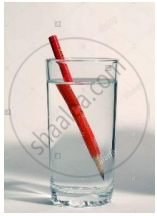
Light changes its direction when going from one transparent medium to another transparent medium. This is called _______.
Write scientific reason.
The bottom of a pond appears raised.
Numerical problems.
The speed of light in water is 2.25 × 10⁸ ms–1. If the speed of light in vacuum is 3 × 10⁸ ms–1, calculate the refractive index of water.
The deviation of light ray from its path when it travels from one transparent medium to another transparent medium is called ______.

The angle of incidence from air to glass at the point O on the hemispherical glass slab is.
The bending of light as it passes from one medium to another is called ______.
The change in the direction of the path of light when it passes from one transparent medium to another transparent medium is called:
When light passes from one transparent medium to another, its direction changes due to:
