Advertisements
Advertisements
Question
Due to _______ pencil looks bent in water, in the given experiment.
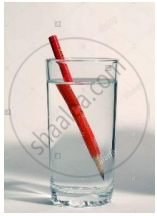
Options
refraction of light
dispersion of light
internal reflection of light
reflection of light
Advertisements
Solution
Due to refraction of light pencil looks bent in water, in the given experiment.
APPEARS IN
RELATED QUESTIONS
If an object is placed at a distance of 10 cm in from of a plane mirror, how far would it be from its image?
What is lateral inversion? Explain by giving a suitable example.
What are the important differences between looking at a photograph of your face and looking at yourself in a plane mirror?
A wall reflects light and a mirror also reflects light. What difference is three in the way they reflect light?
State the uses of plane mirrors.
Write all the capital letters of the alphabet which look the same in a plane mirror.
A man stands 10 m in front of a large plane mirror. How far must the walk before he is 5 m away from his image?
A man sits in an optician's chair looking into plane mirror which is 2 m away from him and views the image of a chart which faces the mirror and is 50 cm behind his head. How far away from his eyes does the chart appear to be?
Explain how to read the following message which was found on some blotting paper:

State two effects caused by the refraction of light.
In which material do you think light rays travel faster-glass or air?
Light travels more quickly through water than through glass.
If a ray of light passes from glass into water, which way will it bend : towards the normal or away from the normal?
With the help of a labelled diagram, explain why a tank full of water appears less deep than it actually is.
- With the help of a diagram, show how when light falls obliquely on the side of a rectangular glass slab, the emergent ray is parallel to the incident ray.
- Show the lateral displacement of the ray on the diagram.
State two factors on which the lateral displacement of the emergent ray depends.
How does the light have to enter the glass:
for no refraction to happen?
Image is formed by a mirror due to refraction of light.
What is the cause of refraction of light when it passes from one medium to another?
Light enters from air to glass having refractive index 1.50. What is the speed of light in the glass? The speed of light in vacuum is 3 × 10⁸ m s−1.
The size of image of an object by a convex lens of focal length 20 cm is observed to be reduced to `1/3` rd of its size . Find the distance of the object from the optical centre of the lens .
List in proper sequence the steps of the experiment for determining the approximate focal length of a given concave mirror by obtaining the image of a distant object.
The laws of reflection hold true for ______.
Lights of different colours are used as signal for safety transport. From these, the wavelength of red light is _______ nm.
The speed of light varies in different media.
Write scientific reason.
The sun appears on the western horizon for some time after sunset.
The angle of incidence for a ray of light having zero reflection angle is ______.
Noor, a young student, was trying to demonstrate some properties of light in her Science project work. She kept ‘X’ inside the box (as shown in the figure) and with the help of a laser pointer made light rays pass through the holes on one side of the box. She had a small butter-paper screen to see the spots of light being cast as they emerged.

Her friend noted the following observations from this demonstration:
- Glass is optically rarer than air.
- Air and glass allow light to pass through them with the same velocity.
- Air is optically rarer than glass.
- Speed of light through a denser medium is faster than that of a rarer medium.
- The ratio: sin of angle of incidence in the first medium to the ratio of sin of angle of refraction in the second medium, gives the refractive index of the second material with respect to the first one.
Which one of the combinations of the above statements given below is correct.
The phenomenon of light passing through the object is called ______.
The bending of light as it passes from one medium to another is called ______.
The ratio of the sine of the angle of incidence to the sine of ______ is constant.
Light is refracted or bent while going from one medium to another because of its ______ changes.
Assertion: The air bubble shines in water.
Reason: Air bubble shines due to the refraction of light.
Why a pencil partly immersed in water appears to be bent at the water surface.
How do twinkling stars occur? (or) what is the cause of the twinkling of stars?
In refraction of light through a glass slab, the directions of the incident ray and the refracted ray are ______.
According to the second law of refraction, for a given pair of media, the ratio of the sine of the angle of incidence to the sine of the angle of refraction:
Which of the following relations is called Snell's Law?
