Advertisements
Advertisements
Question
If an object is placed at a distance of 10 cm in from of a plane mirror, how far would it be from its image?
Advertisements
Solution
It will be 20 cm away from its image. This is because the distance of the plane mirror from the object is equal to its distance from the image.
APPEARS IN
RELATED QUESTIONS
What is lateral inversion? Explain by giving a suitable example.
The image of an object formed by a plane mirror is:
(a) virtual
(b) real
(c) diminished
(d) upside-down
Fill in the following blank with suitable word:
Light bends when is passes from water into air. We say that it is ............
Image is formed by a mirror due to refraction of light.
Choose and write the correct option.
If we gradually increase the angle of incidence of a ray of light passing through prism then …..
What is atmospheric reflection? Explain with the help of a labelled diagram that the position of a star as seen by us is not its true position.
A real image is formed by the light rays after reflection or refraction when they:
- actually meet or intersect with each other.
- actually converge at a point.
- appear to meet when they are produced in the backward direction.
- appear to diverge from a point.
Which of the above statements are correct?
The laws of reflection hold true for ______.
Due to _______ pencil looks bent in water, in the given experiment.
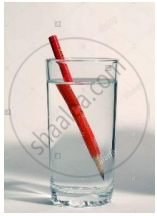
Write scientific reason.
A pencil appears to be broken near the surface of water.
Observe the given figure and write appropriate phenomenon of light in the box.
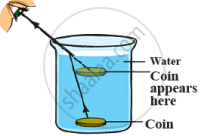
Assertion and reasoning type
- Assertion: If the refractive index of the medium is high (denser medium) the velocity of the light in that medium will be small
- Reason: Refractive index of the medium is inversely proportional to the velocity of the light
What is refractive index?
The deviation of light ray from its path when it travels from one transparent medium to another transparent medium is called ______.

The angle of incidence from air to glass at the point O on the hemispherical glass slab is.
Noor, a young student, was trying to demonstrate some properties of light in her Science project work. She kept ‘X’ inside the box (as shown in the figure) and with the help of a laser pointer made light rays pass through the holes on one side of the box. She had a small butter-paper screen to see the spots of light being cast as they emerged.

Her friend noted the following observations from this demonstration:
- Glass is optically rarer than air.
- Air and glass allow light to pass through them with the same velocity.
- Air is optically rarer than glass.
- Speed of light through a denser medium is faster than that of a rarer medium.
- The ratio: sin of angle of incidence in the first medium to the ratio of sin of angle of refraction in the second medium, gives the refractive index of the second material with respect to the first one.
Which one of the combinations of the above statements given below is correct.
A ray of light traveling in medium 1 strikes and travels into another transparent medium 2. If the speed of light is greater in medium 1, the ray will ______.
Assertion: The air bubble shines in water.
Reason: Air bubble shines due to the refraction of light.
A ray of light starting from diamond is incident on the interface separating diamond and water. Draw a labelled ray diagram to show. the refraction of light in this case.
A normal is an imaginary line drawn ________ to the boundary at the point of incidence.
