Advertisements
Advertisements
Question
In refraction of light through a glass slab, the directions of the incident ray and the refracted ray are ______.
Options
Perpendicular to each other.
Non-parallel to each other.
Parallel to each other.
Intersecting each other.
Advertisements
Solution
In the refraction of light through a glass slab, the directions of the incident ray and the refracted ray are parallel to each other.
Explanation:
For refraction to happen the light ray will have to incident obliquely. If the light ray is incident on the glass slab at a zero angle of incidence the ray will travel without any change of direction.
APPEARS IN
RELATED QUESTIONS
| Column I | Column II | Column III | |
| 1 | Dispersion | Long-sightedness | Twinkling of stars |
| 2 | Refraction | Splitting of white light into component colours | Convex lens |
| 3 | Hypermetropia | Change in the direction of the ray of light due to change in medium | Spectrum of seven colours |
If an object is placed at a distance of 10 cm in from of a plane mirror, how far would it be from its image?
Which property of light makes a pencil cast a shadow when it is held in front of a light source?
A wall reflects light and a mirror also reflects light. What difference is three in the way they reflect light?
Which type of reflection of light leads to the formation of images?
With the help of a labelled ray-diagram, describe how a plane mirror forms an image of a point source of light placed in front of it. State the characteristics of the image formed in a plane mirror.
Write all the capital letters of the alphabet which look the same in a plane mirror.
The figure given alongside shows the image of a clock as seen in a plane mirror. The correct time is:
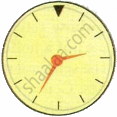
An object is placed 20 cm in front of a plane mirror. The mirror is moved 2 cm towards the object. The distance between the positions of the positions of the original and final images seen in the mirror is ______.
As light rays pass from water into glass, are they refracted towards the normal or away from the normal?
In which material do you think light rays travel faster-glass or air?
Which phenomenon of light makes the water to appear shallower than it really is?
What is meant by the ‘angle of incidence’ for a ray of light?
Show the lateral displacement of the ray on the diagram.
When a ray of light travelling in glass enters into water obliquely ______.
Air is optically .......... than glass.
Draw suitable diagrams to illustrate how a beam of light incident parallel to the principal axis is reflected by:
(a) a concave mirror, and (b) a convex mirror
Define the principal focus of a concave mirror.
A real image is formed by the light rays after reflection or refraction when they:
- actually meet or intersect with each other.
- actually converge at a point.
- appear to meet when they are produced in the backward direction.
- appear to diverge from a point.
Which of the above statements are correct?
Write scientific reason.
The sun appears on the western horizon for some time after sunset.
Write scientific reason.
A pencil appears to be broken near the surface of water.
Observe the given figure and write appropriate phenomenon of light in the box.
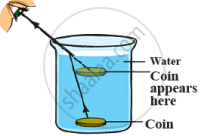
State whether true or false. If false, correct the statement.
The angle of deviation depends on the refractive index of the glass.
The refractive index of a transparent medium is always greater than ______.
Assertion and reasoning type
- Assertion: If the refractive index of the medium is high (denser medium) the velocity of the light in that medium will be small
- Reason: Refractive index of the medium is inversely proportional to the velocity of the light
The angle of incidence for a ray of light having zero reflection angle is ______.
If a beam of red light and a beam of violet light are incident at the same angle on the inclined surface of a prism from air medium and produce angles of refraction r and v respectively, which of the following is correct?
Which object use the reflection of light?
When light passes from one medium to another the ray gets bent. This property of light is called ______.
How does the light travel?
Light bends as it passes from one medium to another. What is this phenomenon called?
A water tank appears shallower when it is viewed from the top due to refraction.
Twinkling of stars and Mirage are the two phenomena occurring due to refraction.
Why a pencil partly immersed in water appears to be bent at the water surface.
A ray of light starting from diamond is incident on the interface separating diamond and water. Draw a labelled ray diagram to show. the refraction of light in this case.
When a light ray passes from a rarer medium to a denser medium, it bends:
Which of the following relations is called Snell's Law?
The absolute refractive index of a medium is given by:
