Advertisements
Advertisements
प्रश्न
In refraction of light through a glass slab, the directions of the incident ray and the refracted ray are ______.
पर्याय
Perpendicular to each other.
Non-parallel to each other.
Parallel to each other.
Intersecting each other.
Advertisements
उत्तर
In the refraction of light through a glass slab, the directions of the incident ray and the refracted ray are parallel to each other.
Explanation:
For refraction to happen the light ray will have to incident obliquely. If the light ray is incident on the glass slab at a zero angle of incidence the ray will travel without any change of direction.
APPEARS IN
संबंधित प्रश्न
What is refraction of light?
Where is the image when you look at something in a mirror?
What is lateral inversion? Explain by giving a suitable example.
A wall reflects light and a mirror also reflects light. What difference is three in the way they reflect light?
What is the difference between regular reflection of light and diffuse reflection of light?
Write all the capital letters of the alphabet which look the same in a plane mirror.
The figure given alongside shows the image of a clock as seen in a plane mirror. The correct time is:
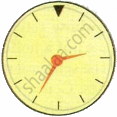
A man stands 10 m in front of a large plane mirror. How far must the walk before he is 5 m away from his image?
An object is placed 20 cm in front of a plane mirror. The mirror is moved 2 cm towards the object. The distance between the positions of the positions of the original and final images seen in the mirror is ______.
As light rays pass from water into glass, are they refracted towards the normal or away from the normal?
Why does a ray of light bend when it travels from one medium to another?
Fill in the following blank with suitable word:
Light bends when is passes from water into air. We say that it is ............
A ray of light travelling in air is incident on a rectangular glass block and emerges out into the air from the opposite face. Draw a labelled ray diagram to show the completer path of this ray of light. Mark the two points where the refraction of light takes place. What can you say about the final direction of ray of light?
What is meant by the ‘angle of incidence’ for a ray of light?
When a light ray passes from air into glass, what happens to its speed? Draw a diagram to show which way the ray of light bends.
- With the help of a diagram, show how when light falls obliquely on the side of a rectangular glass slab, the emergent ray is parallel to the incident ray.
- Show the lateral displacement of the ray on the diagram.
Show the lateral displacement of the ray on the diagram.
When a ray of light travelling in glass enters into water obliquely ______.
A ray of light passes from a medium X to another medium Y. No refraction of light occurs if the ray of light hits the boundary of medium Y at an angle of:
(a) 0°
(b) 45°
(c) 90°
(d) 120°
A vertical ray of light strikes the horizontal surface of some water:
What is the angle of refraction?
Match the Following
| Column A | Column B |
| (a) white Light | (1) Convex mirror |
| (b) Refraction | (2) Concave mirror |
| (c) Virtual images | (3) refraction |
| (d) Real images | (4) spectrum |
| (e) Prism | (5) ray of light from glass to air |
List in proper sequence the steps of the experiment for determining the approximate focal length of a given concave mirror by obtaining the image of a distant object.
The phenomenon of change in the direction of light when it passes from one transparent medium to another is called ___________.
Light changes its direction when going from one transparent medium to another transparent medium. This is called _______.
Why does a ray of light bend when it travels from one medium to another?
What is refractive index?
A pencil when dipped in water in a glass tumbler appears to be bent at the interface of air and water. Will the pencil appear to be bent to the same extent, if instead of water we use liquids like, kerosene or turpentine. Support your answer with reason.
Light bends as it passes from one medium to another. What is this phenomenon called?
Light travels fastest in a vacuum. Why?
The ratio of the sine of the angle of incidence to the sine of ______ is constant.
Under what circumstances there won’t be any refraction of light when it enters from one medium to another?
Why a pencil partly immersed in water appears to be bent at the water surface.
Match the following:
| Column I | Column II | ||
| 1. | r > 90 | a. | Light gazes at the surface of separation between the two modes. |
| 2. | r = 90 | b. | No refraction. |
| 3. | r < 90 | c. | Refracted ray away from the normal |
The ray that enters the second medium after crossing the boundary is called the:
When light travels from a denser medium to a rarer medium, its speed:
According to the second law of refraction, for a given pair of media, the ratio of the sine of the angle of incidence to the sine of the angle of refraction:
The absolute refractive index of a medium is given by:
To a crane, a fish appears 6 cm below the water surface. Taking the refractive index of water as \[\frac{4}{3}\], the real depth of the fish below the surface is:
