Advertisements
Advertisements
प्रश्न
In refraction of light through a glass slab, the directions of the incident ray and the refracted ray are ______.
विकल्प
Perpendicular to each other.
Non-parallel to each other.
Parallel to each other.
Intersecting each other.
Advertisements
उत्तर
In the refraction of light through a glass slab, the directions of the incident ray and the refracted ray are parallel to each other.
Explanation:
For refraction to happen the light ray will have to incident obliquely. If the light ray is incident on the glass slab at a zero angle of incidence the ray will travel without any change of direction.
APPEARS IN
संबंधित प्रश्न
What is refraction of light?
If an object is placed at a distance of 10 cm in from of a plane mirror, how far would it be from its image?
What is lateral inversion? Explain by giving a suitable example.
Write the word AMBULANCE as it would appear when reflected in a plane mirror. Why is it sometimes written in this way (as its mirror image) on the front of an ambulance?
State and explain the laws of reflection of light at a plane surface (like a plane mirror), With the help of a labelled ray-diagram. Mark the angles of 'incidence' and 'reflection' clearly on the diagram. If the angle of reflection is 47.5°, what will be the angle of incidence?
With the help of a labelled ray-diagram, describe how a plane mirror forms an image of a point source of light placed in front of it. State the characteristics of the image formed in a plane mirror.
The angle of reflection is equal to the angle of incidence:
(a) always
(b) sometimes
(c) under special conditions
(d) never
The image formed by a plane mirror is :
(a) virtual, behind the mirror and enlarged.
(b) virtual, behind the mirror and of the same size as the object.
(c) real, at the surface of the mirror and enlarged.
(d) real, behind the mirror and of the same size as the object.
A ray of light strikes a plane mirror PQ at an angle of incidence of 30°, is reflected from the plane mirror and then strikes a second plane mirror QR placed at right angles to the first mirror. The angle of reflection at the second mirror is ______.
Explain how to read the following message which was found on some blotting paper:

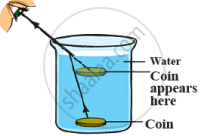
Name the phenomenon due to which a swimming pool appears less deep than it really is.
In which material do you think light rays travel faster-glass or air?
Fill in the following blank with suitable word:
Light travelling along a normal is ...............refracted.
Name the phenomenon due to which a pencil partly immersed in water and held obliquely appears to be bent at the water surface.
Explain with the help of a labelled ray diagram, why a pencil partly immersed in water appears to be bent at the water surface. State whether the bending of pencil will increase or decrease if water is replaced by another liquid which is optically more dense than water. Give reason for your answer.
Light travelling from a denser medium to a rarer medium along a normal to the boundary:
(a) is refracted towards the normal
(b) is refracted away from the normal
(c) goes along the boundary
(d) is not refracted
When a ray of light travelling in glass enters into water obliquely ______.
A ray of light when passes from glass to air, bends towards the normal.
Air is optically .......... than glass.
When a ray of light travels from water to air, it bends ............. the normal.
Match the Following
| Column A | Column B |
| (a) white Light | (1) Convex mirror |
| (b) Refraction | (2) Concave mirror |
| (c) Virtual images | (3) refraction |
| (d) Real images | (4) spectrum |
| (e) Prism | (5) ray of light from glass to air |
What do you understand by refraction of light?
What is the cause of refraction of light when it passes from one medium to another?
A ray of light passes from medium 1 to medium 2. Which of the following quantities of the refracted ray will differ from that of the incident ray: Speed, intensity, frequency, wavelength?
We can see the sun even when it is little below the horizon because of ______.
The phenomenon of change in the direction of light when it passes from one transparent medium to another is called ___________.
Identify the wrong figure from the following.
The speed of light varies in different media.
Write scientific reason.
The bottom of a pond appears raised.
Observe the given figure and write appropriate phenomenon of light in the box.
A ray of light traveling in medium 1 strikes and travels into another transparent medium 2. If the speed of light is greater in medium 1, the ray will ______.
The ray that enters the second medium after crossing the boundary is called the:
When light travels from a denser medium to a rarer medium, its speed:
According to the first law of refraction, the incident ray, the refracted ray, and the normal at the point of incidence:
According to the second law of refraction, for a given pair of media, the ratio of the sine of the angle of incidence to the sine of the angle of refraction:
The absolute refractive index of a medium is given by:
In the formula for absolute refractive index \[n = \frac{c}{v}\], the quantity c represents:
