Advertisements
Advertisements
प्रश्न
A boy with a mouth 5 cm wide stands 2 m away from a plane mirror. Where is his image and how wide is the image of his mouth?
Advertisements
उत्तर
The image formed is 2m behind the mirror and 5 cm wide. The reason being, a plane mirror forms an image of the same size as the object, and at the same distance behind the mirror as that of the object from the mirror.
APPEARS IN
संबंधित प्रश्न
Which property of light makes a pencil cast a shadow when it is held in front of a light source?
State the uses of plane mirrors.
Explain how to read the following message which was found on some blotting paper:

If a ray of light goes form a denser medium to a rarer medium, will it bend towards the normal or away from the normal?
State whether the following statement is true or false:
Refraction occurs because light slows down in denser materials.
Why does a ray of light bend when it travels from one medium to another?
A coin in a glass tumbler appears to rise as the glass tumbler is slowly filled with water. Name the phenomenon responsible for this effect.
The speed of light is more in glass than in water.
Light travels at a lower speed in water than in air.
The size of image of an object by a convex lens of focal length 20 cm is observed to be reduced to `1/3` rd of its size . Find the distance of the object from the optical centre of the lens .
Due to _______ pencil looks bent in water, in the given experiment.
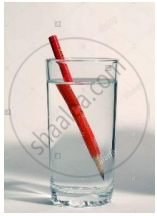
You are given water, mustard oil, glycerine and kerosene. In which of these media a ray of light incident obliquely at same angle would bend the most?
The angle of incidence for a ray of light having zero reflection angle is ______.
Light bends as it passes from one medium to another. What is this phenomenon called?
Twinkling of stars and Mirage are the two phenomena occurring due to refraction.
Under what circumstances there won’t be any refraction of light when it enters from one medium to another?
Match the following:
| Column I | Column II | ||
| 1. | r > 90 | a. | Light gazes at the surface of separation between the two modes. |
| 2. | r = 90 | b. | No refraction. |
| 3. | r < 90 | c. | Refracted ray away from the normal |
A normal is an imaginary line drawn ________ to the boundary at the point of incidence.
Which of the following relations is called Snell's Law?
The absolute refractive index of a medium is given by:
