Advertisements
Online Mock Tests
Chapters
![Lakhmir Singh solutions for फिज़िक्स पार्ट १ [अंग्रेजी] कक्षा १० chapter 1 - Reflection of Light - Shaalaa.com](/images/physics-part-1-english-class-10_6:5e8f817651d047a288d517e10b532fb7.jpg "Lakhmir Singh solutions for फिज़िक्स पार्ट १ [अंग्रेजी] कक्षा १० chapter 1 - Reflection of Light")
Advertisements
Solutions for Chapter 1: Reflection of Light
Below listed, you can find solutions for Chapter 1 of CBSE, Karnataka Board Lakhmir Singh for फिज़िक्स पार्ट १ [अंग्रेजी] कक्षा १०.
Lakhmir Singh solutions for फिज़िक्स पार्ट १ [अंग्रेजी] कक्षा १० 1 Reflection of Light Exercise 1 [Pages 21 - 23]
Very Short Answer Type Questions
What happens when a ray of light falls normally (or perpendiculary) on the surface of a plane mirror?
A ray of light is incident on a plane mirror at an angle of 30°. What is the angle of reflection
A ray of light strikes a plane mirror at an angle of 40° to the mirror surface. What will be the angle of reflection?
A ray of light is incident normally on a plane mirror. What will be the:
- angle of incidence?
- angle of reflection?
What type of image is formed:
- in a plane mirror?
- on a cinema screen?
What kind of mirror is required for obtaining a virtual image of the same size as the object?
What is the name of the phenomenon in which the right side of an object appears to be the left side of the image in a plane mirror?
Name the phenomenon responsible for the following effect:
When we sit in front of a plane mirror and write with our right hand, it appears in the mirror that we are writing with the left hand.
If an object is placed at a distance of 10 cm in from of a plane mirror, how far would it be from its image?
Which property of light makes a pencil cast a shadow when it is held in front of a light source?
The image seen in a plane mirror cannot be formed on a screen. What name is given to this type of image?
Fill in the following blank with a suitable word:
When light is reflected, the angles of incidence and reflection are ............ .
State whether the following statement is true of false:
A student says that we can see an object because light from our eyes is reflected back by the object.
Where is the image when you look at something in a mirror?
A ray of light strikes a plane mirror such that its angle of incidence is 30°. What angle does the reflected ray make with the mirror surface?
Short Answer Type Questions
What is the difference between a real image and a virtual image? Give one example of each type of image
The letter F is placed in front of a plane mirror:
- How would its image look like when seen in a plane mirror?
- What is the name of the phenomenon involved?
What is lateral inversion? Explain by giving a suitable example.
Write the word AMBULANCE as it would appear when reflected in a plane mirror. Why is it sometimes written in this way (as its mirror image) on the front of an ambulance?
What are the important differences between looking at a photograph of your face and looking at yourself in a plane mirror?
A wall reflects light and a mirror also reflects light. What difference is three in the way they reflect light?
Which type of reflection of light leads to the formation of images?
What is the difference between regular reflection of light and diffuse reflection of light?
What type of reflection of light takes place from a cinema screen?
What type of reflection of light takes place from a plane mirror?
What type of reflection of light takes place from a cardboard?
What type of reflection of light takes place from the still water surface of a lake?
What can you see in a completely dark room? If you switch on an electric bulb in this dark room as a light source, explain how you could now see:
(a) the electric bulb
(b) a piece of white paper
A boy with a mouth 5 cm wide stands 2 m away from a plane mirror. Where is his image and how wide is the image of his mouth?
The boy walks towards the mirror at a speed of 1 m/s. At what speed does his image approach him?
An extended object in the form of an arrow pointing upward has been placed in front of a plane mirror. Draw a labelled ray-diagram to show the formation of its image.
State the uses of plane mirrors.
Long Answer Type Questions
What is meant by 'reflection of light'?
Define the following terms used in the study of reflection of light by drawing a labelled ray-diagram:
- Incident ray
- Point of incidence
- Normal
- Reflected ray
- Angle of incidence
- Angle of reflection
State and explain the laws of reflection of light at a plane surface (like a plane mirror), With the help of a labelled ray-diagram. Mark the angles of 'incidence' and 'reflection' clearly on the diagram. If the angle of reflection is 47.5°, what will be the angle of incidence?
With the help of a labelled ray-diagram, describe how a plane mirror forms an image of a point source of light placed in front of it. State the characteristics of the image formed in a plane mirror.
Explain why, though both a plane mirror and a sheet of paper reflect light but we can see the image of our face in a plane mirror but not in a sheet of paper.
The image in a plane mirror is virtual and laterally inverted. What does this statement mean?
Write all the capital letters of the alphabet which look the same in a plane mirror.
Multiple Choice Questions (MCQs)
The angle of reflection is equal to the angle of incidence:
(a) always
(b) sometimes
(c) under special conditions
(d) never
The angle between an incident ray and the plane mirror is 30°. The total angle between the incident ray and reflected ray will be:
(a) 30°
(b) 60°
(c) 90°
(d) 120°
A ray of light is incident on a plane mirror making an angle of 90° with the mirror surface. The angle of reflection for this ray of light will be:
(a) 45°
(b) 90°
(c) 0°
(d) 60°
The image of an object formed by a plane mirror is:
(a) virtual
(b) real
(c) diminished
(d) upside-down
The image formed by a plane mirror is :
(a) virtual, behind the mirror and enlarged.
(b) virtual, behind the mirror and of the same size as the object.
(c) real, at the surface of the mirror and enlarged.
(d) real, behind the mirror and of the same size as the object.
The figure given alongside shows the image of a clock as seen in a plane mirror. The correct time is:
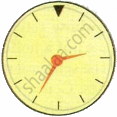
2.25
2.35
6.45
9.25
Questions Based on High Order Thinking Skills (HOTS)/Case Based Questions
A man stands 10 m in front of a large plane mirror. How far must the walk before he is 5 m away from his image?
An object is placed 20 cm in front of a plane mirror. The mirror is moved 2 cm towards the object. The distance between the positions of the positions of the original and final images seen in the mirror is ______.
2 cm
4 cm
10 cm
22 cm
A man sits in an optician's chair looking into plane mirror which is 2 m away from him and views the image of a chart which faces the mirror and is 50 cm behind his head. How far away from his eyes does the chart appear to be?
A ray of light strikes a plane mirror PQ at an angle of incidence of 30°, is reflected from the plane mirror and then strikes a second plane mirror QR placed at right angles to the first mirror. The angle of reflection at the second mirror is:
Draw a ray-diagram to illustrate your answer.
30°
45°
60°
90°
Explain how to read the following message which was found on some blotting paper:

Lakhmir Singh solutions for फिज़िक्स पार्ट १ [अंग्रेजी] कक्षा १० 1 Reflection of Light Exercise 2 [Pages 27 - 28]
Very Short Answer Type Questions
Name the spherical mirror which has:
(a) virtual principal focus.
(b) real principal focus.
Out of convex mirror and concave mirror, whose focus is situated behind the mirror?
Find the focal length of a concave mirror whose radius of curvature is 32 cm.
If the focal length of a convex mirror is 25 cm, what is its radius of curvature?
Fill in the following blank with suitable word:
Parallel rays of light are reflected by a concave mirror to a point called the ..........
Fill in the following blank with suitable word:
The focal length of a concave mirror is the distance from the ......... to the mirror.
A concave mirror ______ rays of light whereas a convex mirror ______ rays of light.
For a convex mirror, parallel rays of light appear to diverge from a point called the ______.
Short Answer Type Questioms
What is a spherical mirror?
Answer the following question:
Distinguish between the convex mirror and the concave mirror.
Name the two types of spherical mirrors. What type of mirror is represented by the:
- back side of a shining steel spoon?
- front side of a shining steel spoon?
What is the relation between the focal length and radius of curvature of a spherical mirror (concave mirror or convex mirror)?
Calculate the focal length of a spherical mirror whose radius of curvature is 25 cm.
Explain with a suitable diagram, how a concave mirror converges a parallel beam of light rays. Mark clearly the pole, focus and centre of curvature of concave mirror in this diagram.
Describe with a suitable diagram, how a convex mirror diverges a parallel beam of light rays. Mark clearly the pole, focus and centre of curvature of convex mirror in this diagram.
Long Answer Type Questions
Define (a) centre of curvature (b) radius of curvature (c) pole (d) principal axis, and (e) aperture, of a spherical mirror with the help of a labelled diagram
Define the principal focus of a concave mirror.
Define the focal length of a concave mirror.
Draw diagram to represent the action of a concave mirror on a beam of parallel light rays. Mark on this diagram principal axis, focus F, centre of curvature C, pole P and focal length f, of the concave mirror.
What is meant by the principal focus of a convex mirror?
What is meant by the focal length of a convex mirror?
Draw diagram to show the action of convex mirror on a beam of parallel light rays. Mark on this diagram principal axis, focus F, centre of curvature C, pole P and focal length f, of the convex mirror.
Multiple Choice Questions (MCQs)
In a convex spherical mirror, reflection of light takes place at:
(a) a flat surface
(b) a bent-in surface
(c) a bulging-our surface
(d) an uneven surface
A diverging mirror is
(a) a plane mirror
(b) a convex mirror
(c) a concave mirror
(d) a shaving mirror
If R is the radius of curvature of a spherical mirror and f is its focal length, then:
(a) R = `f`
(b) R =` 2f`
(c) R = `f/2`
(d) R = `3f`
The focal length of a spherical mirror of radius of curvature 30 cm is:
(a) 10 cm
(b) 15 cm
(c) 20 cm
(d) 30 cm
If the focal length of a spherical mirror is 12.5 cm, its radius of curvature will be:
(a) 25 cm
(b) 15 cm
(c) 20 cm
(d) 35 cm
Questions Based on High Order Thinking Skills (HOTS)/Case Based Questions
A communications satellite in orbit sends a parallel beam of signals down to earth. If these signals obey the same laws of reflection as light and are to be focussed onto a small receiving aerial, what should be the best shape of the metal 'dish' used to collect them?
When a spherical mirror is held towards the sun and its sharp image is formed on a piece of carbon paper for some time, a hole is burnt in the carbon paper.
- What is the nature of spherical mirror?
- Why is a hole burnt in the carbon paper?
- At which point of the spherical mirror the carbon paper is placed?
- What name is given to the distance between spherical mirror and carbon paper?
- What is the advantage of using a carbon paper rather than a white paper?
Lakhmir Singh solutions for फिज़िक्स पार्ट १ [अंग्रेजी] कक्षा १० 1 Reflection of Light Exercise 3 [Pages 39 - 42]
Very Short Answer Type Questions
For what position of an object, a concave mirror forms a real image equal in size to the object?
Where should an object be placed in front of the concave mirror so as to obtain its virtual, erect and magnified image?
For which positions of the object does a concave mirror produce an inverted, magnified an real image?
If an object is placed at the focus of a concave mirror, where is the image formed?
If an object is at infinity (very large distance) in front of a concave mirror, where is the image formed?
For what position of an object, a real and diminished image is formed by a concave mirror?
Copy this figure in your answer book and show the direction of the light ray after reflection:

Draw the following diagram in your answer book and show the formation of image of the object AB with the help of suitable rays:

Draw the following diagram in your answer book and show the formation of image with the help of suitable rays:

Which type of mirror could be used as a dentist's mirror?
Short Answer Type Questions
Which kind of mirror is used in the headlights of a car? Why is it used for this purpose?
Explain why, a ray of light passing through the centre of curvature of a concave mirror gets reflected back along the same path.
What is the minimum number of rays required for locating the image formed by a concave mirror for an object? Draw a ray diagram to show the formation of a virtual image by a concave mirror.
With the help of a ray diagram, determine the position, nature and size of the image formed of an object placed at the centre of curvature of a concave mirror.
Described with the help of a diagram, the nature, size and position of the image formed when an object is placed beyond the centre of curvature of a concave mirror.
If an object is placed at a distance of 8 cm from a concave mirror of focal length 10 cm, discuss the nature of the image formed by drawing the ray diagram.
Draw a ray diagram showing how a concave mirror can be used to produce a real, inverted and diminished image of an object.
Which mirror is used as a torch reflector? Draw a labelled diagram to show how a torch reflector can be used to produce a parallel beam of light. Where is the bulb placed in relation to the torch reflector?
State where an object must be placed so that the image formed by a concave mirror is:
(b) at infinity.
(c) the same size as the object.
With the help of a labelled ray diagram, describe how a converging mirror can be used to give an enlarged upright image of an object.
Make labelled ray diagrams to illustrate the formation of:
- a real image by a converging mirror.
- a virtual image by a converging mirror.
Mark clearly the pole, focus, centre of curvature and position of object in each case.
Briefly describe how you would find the focal length of a concave mirror quickly but approximately
Which type of mirror is used in a solar furnace? Support your answer with reason.
Name the type of mirror used by dentists. How does it help?
Explain why, concave mirrors are used as shaving mirrors.
Give two uses of concave mirrors. Explain why you would choose concave mirrors for these uses.
Long Answer Type Questions
- Draw ray-diagrams to show the formation of images when the object is placed in front of a concave mirror (converging mirror):
- between its pole and focus
- between its centre of curvature and focus.
Describe the nature, size and position of the image formed in each case.
- State one use of concave mirror based on the formation of image as in case (i) above.
- Give two circumstances in which a concave mirror can form a magnified image of an object placed in front of it. Illustrate your answer by drawing labelled ray diagrams for both.
- Which one of these circumstances enables a concave mirror to be used as a shaving mirror?
Multiple Choice Questions (MCQs)
The real image formed by a concave mirror is larger than the object when object is:
(a) at a distance equal to radius of curvature
(b) at a distance less than the focal length
(c) between focus and centre of curvature
(d) at a distance greater than radius of curvature
The real image formed by a concave mirror is smaller than the object if the object is:
(a) between centre of curvature and focus
(b) at a distance greater than radius of curvature
(c) at a distance equal to radius of curvature
(d) at a distance equal to focal length
The image formed by a concave mirror is virtual, erect and magnified. The position of object is:
(a) at focus
(b) between focus and centre of curvature
(c) at pole
(d) between pole and focus
The image formed by a concave mirror is real, inverted and of the same size as the object. The position of the object must then be:
(a) at the focus
(b) between the centre of curvature and focus
(c) at the centre of curvature
(d) beyond the centre of curvature
The image formed by a concave mirror is real, inverted and highly diminished (much smaller than the object). The object must be:
(a) between pole and focus
(b) at focus
(c) at the centre of curvature
(d) at infinity
The angle of incidence for of light passing through the centre of curvature of a concave mirror is:
(a) 45°
(b) 90°
(c) 0°
(d) 180°
In the concave reflector of a torch, the bulb is placed:
(a) between the pole and focus of reflector
(b) at the focus of reflector
(c) between focus and centre of curvature of reflector
(d) at the centre of curvature of reflector
The focal length of a small concave mirror is 2.5 cm. In order to use this concave mirror as a dentist's mirror, the distance of tooth from the mirror should be:
(a) 2.5 cm
(b) 1.5 cm
(c) 4.5 cm
(d) 3.5 cm
Questions Based on High Order Thinking Skills (HOTS)/Case Based Questions
An object is 100 mm in front of a concave mirror which produces an upright (erect image). The radius of curvature of the mirror is ______.
Less than 100 mm
Between 100 mm and 200 mm
Exactly 200 mm
More than 200 mm
A virtual, erect and magnified image of an object is to be produced with a concave mirror of focal length 12 cm. Which of the following object distance should be chosen for this purpose?
(i) 10 cm
(ii) 15 cm
(iii) 20 cm
Give reason for your choi
A concave mirror has a focal length of 25 cm. At which of the following distance should a person hold his face from this concave mirror so that it may act as a shaving mirror?
(a) 45 cm
(b) 20 cm
(c) 25 cm
(d) 30 cm
Give reason for your choice.
An object is placed at the following distances from a concave mirror of focal length 15 cm, turn by turn:
(a) 35 cm
(b) 30 cm
(c) 20 cm
(d) 10 cm
Which position of the object will produce:
(i) a magnified real image?
(ii) a magnified virtual image?
(iii) a diminished real image?
(iv) an image of same size as the object?
Lakhmir Singh solutions for फिज़िक्स पार्ट १ [अंग्रेजी] कक्षा १० 1 Reflection of Light Exercise 4 [Pages 43 - 44]
Very Short Answer Type Questions
According to the “New Cartesian Sign Convention” for mirrors, what sign has been given to the focal length of:
- a concave mirror?
- a convex mirror?
Which type of mirror has:
- positive focal length?
- negative focal length?
What is the nature of a mirror having a focal length of, +10 cm?
What kind of mirror can have a focal length of, −20 cm?
Complete the following sentence:
All the distances are measured from the .......... of a spherical mirror.
What sign (+ve or −ve) has been given to the following on the basis of Cartesian Sign Convention?
- Height of a real image.
- Height of a virtual image.
Short Answer Type Questions
Describe the New Cartesian Sigh Convention used in optics. Draw a labelled diagram to illustrate this sign convention.
According to New Cartesian Sign Convention:
(a) focal length of concave mirror is positive and that of convex mirror is negative
(b) focal length of both concave and convex mirrors is positive
(c) focal length of both concave and convex mirrors is negative
(d) focal length of concave mirror is negative and that of convex mirror is positive
Giving reasons, state the 'signs' (positive or negative) which can be given to the following:
(a) object distance (u) for a concave mirror or convex mirror
(b) image distance (v) for a concave mirror
(c) image distance (v) for a convex mirror
Multiple Choice Questions (MCQs)
According to New Cartesian Sign Convention:
(a) focal length of concave mirror is positive and that of convex mirror is negative
(b) focal length of both concave and convex mirrors is positive
(c) focal length of both concave and convex mirrors is negative
(d) focal length of concave mirror is negative and that of convex mirror is positive
One of the following does not apply to a concave mirror this is:
(a) focal length is negative
(b) image distance can be positive or negative
(c) image distance is always positive
(d) height of image can be positive or negative
Lakhmir Singh solutions for फिज़िक्स पार्ट १ [अंग्रेजी] कक्षा १० 1 Reflection of Light Exercise 5 [Pages 50 - 53]
Very Short Answer Type Questions
If the magnification of a body of size 1 m is 2, what is the size of the image?
What is the position of the image when an object is placed at a distance of 20 cm from a concave mirror of focal length 20 cm?
What is the nature of image formed by a concave mirror if the magnification produced by the mirror
+4
What is the nature of image formed by a concave mirror if the magnification produced by the mirror
−2?
State the relation between object distance, image distance and focal length of a spherical mirror (concave mirror or convex mirror).
Write the mirror formula. Give the meaning of each symbol which occurs in it.
What is the ratio of the height of an image to the height of an object known as?
Define linear magnification produced by a mirror.
Write down a formula for the magnification produced by a concave mirror.
In terms of height of object and height of image.
Write down a formula for the magnification produced by a concave mirror.
In terms of object distance and image distance.
Describe the nature of image formed when the object is placed at a distance of 20 cm from a concave mirror of focal length 10 cm
If the magnification has a plus sign, then image is ______ and ______.
If the magnification has a minus sign, then the image is ______ and ______.
Short Answer Type Questions
An object is placed at a distance of 10 cm from a concave mirror of focal length 20 cm.
- Draw a ray diagram for the formation of image.
- Calculate the image distance.
- State two characteristics of the image formed.
If an object of 10 cm height is placed at a distance of 36 cm from a concave mirror of focal length 12 cm, find the position, nature and height of the image.
At what distance from a concave mirror focal length 10 cm should an object 2 cm long be placed in order to get an erect image 6 cm tall?
When an object is placed at a distance of 15 cm from a concave mirror, its image is formed at 10 cm in front of the mirror. Calculate the focal length of the mirror.
An object 3 cm high is placed at a distance of 8 cm from a concave mirror which produces a virtual image 4.5 cm high:
(i) What is the focal length of the mirror?
(ii) What is the position of image?
(iii) Draw a ray-diagram to show the formation of image.
A converging mirror forms a real image of height 4 cm of an object of height 1 cm placed 20 cm away from the mirror:
- Calculate the image distance.
- What is the focal length of the mirror?
An object of size 7.0 cm is placed at 27 cm in front of a concave mirror of focal length 18 cm. At what distance from the mirror should a screen be placed, so that a sharp focused image can be obtained? Find the size and the nature of the image.
An object 3 cm high is placed at a distance of 10 cm in front of a converging mirror of focal length 20 cm. Find the position, nature, and size of the image formed.
A concave mirror has a focal length of 4 cm and an object 2 cm tall is placed 9 cm away from it. Find the nature, position and size of the image formed.
When an object is placed 20 cm from a concave mirror, a real image magnified three times is formed. Find:
(a) the focal length of the mirror.
(b) Where must the object be placed to give a virtual images three times the height of the object?
A dentist's mirror has a radius of curvature of 3 cm. How far must it be placed from a small dental cavity to give a virtual image of the cavity that is magnified five times?
A large concave mirror has a radius of curvature of 1.5 m. A person stands 10 m in front of the mirror. Where is the person's image?
An object of 5.0 cm size is placed at a distance of 20.0 cm from a converging mirror of focal length 15.0 cm. At what distance from the mirror should a screen be placed to get the sharp image? Also calculate the size of the image.
A concave mirror produces three times enlarged virtual image of an object placed at 10 cm in front of it. Calculate the radius of curvature of the mirror.
A bright object 50 mm high stands on the axis of a concave mirror of focal length 100 mm and at a distance of 300 mm from the concave mirror. How big will the image be?
How far should an object be placed from the pole of a converging mirror of focal length 20cm to form a real image of the size exactly `1/4`th the size of the object?
When an object is placed at a distance of 50 cm from a concave spherical mirror, the magnification produced is, `-1/2`. Where should the object be placed to get a magnification of, `-1/5`?
An object is placed (a) 20 cm, (b) 4 cm, in front of a concave mirror of focal length 12 cm. Find the nature and position of the image formed in each case.
A concave mirror produces a real image 1 cm tall of an object 2.5 mm tall placed 5 cm from the mirror. Find the position of the image and the focal length of the mirror.
A man holds a spherical shaving mirror of radius of curvature 60 cm, and focal length 30 cm, at a distance of 15 cm, from his nose. Find the position of image, and calculate the magnification.
Long Answer Type Questions
An object is placed just outside the principal focus of concave mirror. Draw a ray diagram to show how the image is formed, and describe its size, position and nature.
If the object is moved further away from the mirror, what changes are there in the position and size of the image?
An object is 24 cm away from a concave mirror and its image is 16 cm from the mirror. Find the focal length and radius of curvature of the mirror, and the magnification of the image.
Multiple Choice Questions (MCQs)
Linear magnification produced by a concave mirror may be:
(a) less than 1 or equal to 1
(b) more than 1 or equal than 1
(c) less than 1, more than 1 or equal to 1
(d) less than 1 or more than 1
Magnification produced by a convex mirror is always:
(a) more than 1
(b) less than 1
(c) equal to 1
(d) more or less than 1
Magnification produced by a convex mirror is always:
(a) more than 1
(b) less than 1
(c) equal to 1
(d) more or less than 1
In order to obtain a magnification of −2 (minus 2) with a concave mirror, the object should be placed:
(a) between pole and focus
(b) between focus and centre of curvature
(c) at the centre of curvature
(d) beyond the centre of curvature
A concave mirror produces magnification of +4. The object is placed:
(a) at the focus
(b) between focus and centre of curvature
(c) between focus and pole
(d) between the centre of curvature
If a magnification of, −1 (minus one) is to be obtained by using a converging mirror, then the object has to be placed:
(a) between pole and focus
(b) at the centre of curvature
(c) beyond the centre of curvature
(d) at infinity
In order to obtain a magnification of, −0.6 (minus 0.6) with a concave mirror, the object must be placed:
(a) at the focus
(b) between pole and focus
(c) between focus and centre of curvature
(d) beyond the centre of curvature
An object is placed at a large distance in front of a concave mirror of radius of curvature 40 cm. The image will be formed in front of the mirror at a distance:
(a) 20 cm
(b) 30 cm
(c) 40 cm
(d) 50 cm
In order to obtain a magnification of, −1.5 with a concave mirror of focal length 16 cm, the object will have to be placed at a distance
(a) between 6 cm and 16 cm
(b) between 32 cm and 16 cm
(c) between 48 cm and 32 cm
(d) beyond 64 cm
Linear magnification (m) produced by a rear view mirror fitted in vehicles:
(a) is equal to one
(b) is less than one
(c) is more than one
(d) can be more less than one depending on the position of object
Questions Based on High Order Thinking Skills (HOTS)/Case Based Questions
Between which two points of concave mirror should an object be placed to obtain a magnification of:
(a) −3
(b) +25
(c) −0.4
At what distance from a concave mirror of focal length 10 cm should an object be placed so that:
- its real image is formed 20 cm from the mirror?
- its virtual image is formed 20 cm from the mirror?
If a concave mirror has a focal length of 10 cm, find the two positions where an object can be placed to give, in each case, an image twice the height of the object.
A mirror forms an image which is 30 cm from an object and twice its height.
(a) Where must the mirror be situated?
(b) What is the radius of curvature?
(c) Is the mirror convex or concave?
Lakhmir Singh solutions for फिज़िक्स पार्ट १ [अंग्रेजी] कक्षा १० 1 Reflection of Light Exercise 6 [Pages 58 - 61]
Very Short Answer Type Questions
What type of image/images are formed by:
a convex mirror?
What type of image/images are formed by:
a concave mirror?
Which mirror has a wider field of view?
If you want to see an enlarged image of your face, state whether you will use a concave mirror or a convex mirror?
Which mirror always produces a virtual, erect and diminished image of an object?
An object is placed at a long distance in front of a convex mirror of radius of curvature 30 cm. State the position of its image.
Name the spherical mirror which can produce a real and diminished image of an object.
Name the spherical mirror which can produce a virtual and diminished image of an object.
One wants to see a magnified image of an object in a mirror. What type of mirror should one use?
Name the mirror which can give:
an erect and diminished image of an object.
Name the mirror which can give:
an erect and enlarged image of an object.
State whether the following statement is true or false:
A diverging mirror is used as a rear-view mirror.
What type of mirror should be used as a shaving mirror?
What type of mirror should be used as a shop security mirror?
Which type or mirror is usually used as a rear-view mirror in motor cars?
What kind of mirrors are used in big shopping centres to watch the activities of the customers?
A ray of light of going towards the focus of a convex mirror becomes parallel to the principal axis after reflection from the mirror. Draw a labelled diagram to represent this situation.
Fill in the following blank with a suitable word:
A ray of light which is parallel to the principal axis of a convex mirror, appears to be coming from ............ after reflection from the mirror.
Short Answer Type Questions
Why does a driver prefer to use a convex mirror as a rear-view mirror in a vehicle?
Why can you not use a concave mirror as a rear-view mirror in vehicles?
Where would the image be formed by a convex mirror if the object is placed:
between infinity and pole of the mirror?
Draw labelled ray-diagrams to show the formation of image in both the case.
Where would the image be formed by a convex mirror if the object is placed:
at infinity?
Draw labelled ray-diagrams to show the formation of image in both the case.
The shiny outer surface of a hollow sphere of aluminium of radius 50 cm is to be used as a mirror:
- What will be the focal length of this mirror?
- Which type of spherical mirror will it provide?
- State whether this spherical mirror will diverge or converge light rays.
What is the advantage of using a convex mirror as rear-view mirror in vehicles as compared to a plane mirror? Illustrate your answer with the help of labelled diagrams.
Give two uses of a convex mirror. Explain why you would choose convex mirror for these uses.
What would your image look like if you stood close to a large:
convex mirror?
What would your image look like if you stood close to a large:
concave mirror?
Which of the following are concave mirrors and which convex mirrors?
Shaving mirrors, Car headlight mirror, Searchlight mirror, Driving mirror, Dentist’s inspection mirror, Torch mirror, Staircase mirror in a double-decker bus, Make-up mirror, Solar furnace mirror, Satellite TV dish, Shop security mirror.
How will you distinguish between a plane mirror, a concave mirror and a convex mirror without touching them?
If a driver has one convex and one plane rear-view mirror, how would the images in each mirror appear different?
Long Answer Type Questions
Draw a labelled ray diagram to show the formation of image of an object by a convex mirror. Mark clearly the pole, focus and centre of curvature on the diagram.
What happens to the image when the object is moved away from the mirror gradually?
State three characteristics of the image formed by a convex mirror.
- Draw a labelled ray diagram to show the formation of image in a convex mirror when the object is at infinity. Mark clearly the pole and focus of the mirror in the diagram.
- State three characteristics of the image formed in this case.
- Draw diagram to show how a convex mirror can be used to give a large field of view.
Multiple Choice Questions (MCQs)
The image formed by a spherical mirror is virtual. The mirror will be:
concave
convex
either concave or convex
metallic
Whatever be the position of the object, the image formed by a mirror is virtual, erect and smaller than the object. The mirror then must be:
(a) plane
(b) concave
(c) convex
(d) either concave or convex
The mirror used by a dentist to examine the teeth of a person is ______.
convex
concave
plane
any one of these
If the image formed is always virtual, the mirror can be:
(a) concave or convex
(b) concave or plane
(c) convex or plane
(d) only convex
A concave mirror cannot be used as:
(a) a magnifying mirror
(b) a torch reflector
(c) a dentist's mirror
(d) a real view mirror
A boy is standing in front of and close to a special mirror. He finds the image of his head bigger than normal, the middle part of his body of the same size, and his legs smaller than normal. The special mirror is made up of three types of mirrors in the following order from top downwards:
(a) Convex, Plane, Concave
(b) Plane, Convex, Concave
(c) Concave, Plane, Convex
(d) Convex, Concave, Plane
The mirror which can form a magnified image of an object is:
(a) convex mirror
(b) plane mirror
(c) concave mirror
(d) both convex and concave mirror
A real image of an object is to be obtained. The mirror required for this purpose is:
(a) convex
(b) concave
(c) plane
(d) either convex or concave
Consider two statements A and B given below:
A: real image is always inverted
B: virtual image is always erect
Out of these two statements:
Only A is true
Only B is true
Both A and B are true
None is true
Questions Based on High Order Thinking Skills (HOTS)/Case Based Questions
The diagrams show the appearance of a fork when placed in front of and close to two mirrors A and B, turn by turn.
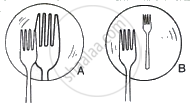
- Which mirror is convex?
- Which mirror is concave?
Give reasons for your choice.
The diagram shows a dish antenna which is used to receive television signals from a satellite. The antenna (signal detector) is fixed in front of the curved dish.
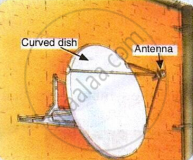
- What is the purpose of the dish?
- Should it be concave or convex?
- Where should the antenna be positioned to receive the strongest possible signals?
- Explain what change you would expect in the signals if a larger dish was used.
A man standing in front of a special mirror finds his image having a very small head, a fat body and legs of normal size. What is the shape of:
(a) top part of the mirror?
(b) middle part of the mirror?
(c) bottom part of the mirror?
Give reasons for your choice.
Two big mirrors A and B are fitted side by side on a wall. A man is standing at such a distance from the wall that he can see the erect image of his face in both the mirrors. When the man starts walking towards the mirrors, he find that the size of his face in mirror A goes on increasing but that in mirror B remains the same.
(a) mirror A is concave and mirror B is convex
(b) mirror A is plane and mirror B is concave
(c) mirror A is concave and mirror B is plane
(d) mirror A is convex and mirror B is concave
Lakhmir Singh solutions for फिज़िक्स पार्ट १ [अंग्रेजी] कक्षा १० 1 Reflection of Light Exercise 7 [Pages 63 - 64]
Very Short Answer Type Questions
An object is kept at a distance of 5 cm in front of a convex mirror of focal length 10 cm. Calculate the position and magnification of the image and state its nature.
An object is placed at a distance of 10 cm from a convex mirror of focal length 5 cm.
(a) Draw a ray-diagram showing the formation image
(b) State two characteristics of the image formed
(c) Calculate the distance of the image from mirror.
An object is placed at a distance of 6 cm from a convex mirror of focal length 12 cm. Find the position and nature of the image.
An object placed 20 cm in front of a mirror is found to have an image 15 cm (a) in front of it, (b) behind the mirror. Find the focal length of the mirror and the kind of mirror in each case.
Short Answer Type Questions
An arrow 2.5 cm high is placed at a distance of 25 cm from a diverging mirror of focal length 20 cm. Find the nature, position and size of the image formed.
A convex mirror used as a rear-view mirror in a car has a radius of curvature of 3 m. If a bus is located at a distance of 5 m from this mirror, find the position of image. What is the nature of the image?
A diverging mirror of radius of curvature 40 cm forms an image which is half the height of the object. Find the object and image positions.
The radius of curvature of a convex mirror used as a rear view mirror in a moving car is 2.0 m. A truck is coming from behind it at a distance of 3.5 m. Calculate (a)
- position, and
- size, of the image relative to the size of the truck.
What will be the nature of the image?
Long Answer Type Question
Draw a diagram to represent a convex mirror. On this diagram mark principal axis, principal focus F and the centre of curvature C if the focal length of convex mirror is 3 cm.
An object 1 cm tall is placed 30 cm in front of a convex mirror of focal length 20 cm. Find the size and position of the image formed by the convex mirror.
Questions Based on High Order Thinking Skills (HOTS)/Case Based Questions
A shop security mirror 5.0 m from certain items displayed in the shop produces on-tenth magnification.
What is the type of mirror?
An object is placed 15 cm from (a) a converging mirror, and (b) a diverging mirror, of radius of curvature 20 cm. Calculate the image position and magnification in each case.
An object 20 cm from a spherical mirror gives rise to virtual image 15 cm behind the mirror. Determine the magnification of the image and the type of mirror used.
Lakhmir Singh solutions for फिज़िक्स पार्ट १ [अंग्रेजी] कक्षा १० 1 Reflection of Light Exercise 8 [Page 64]
Questions Based on Assertion-Reason
In the following questions, two statements are given-one labelled Assertion (A) and the other labelled Reason (R): Select the correct answer to these questions from the options given below:
Assertion (A): For a plane mirror, the angle of reflection is always equal to the angle of incidence.
Reason (R): If an incident ray makes an angle of 35° with the surface of a plane mirror, then the angle of reflection will also be 35°.
Both A and R are true and R is correct explanation of the assertion.
Both A and R are true but R is not the correct explanation of the assertion.
A is true but R is false.
A is false but R is true.
Assertion (A): A ray of light which is incident normally (or perpendicularly) on a mirror, is reflected back along the same path.
Reason (R): When a ray of light falls perpendicularly, it means that it goes along the ‘normal’ to the mirror surface. The angle of incidence as well as the angle of reflection for such a ray of light are zero, and hence it is reflected back along the same path.
Both A and R are true and R is correct explanation of the assertion.
Both A and R are true but R is not the correct explanation of the assertion.
A is true but R is false.
A is false but R is true.
Assertion (A): If the focal length of a converging mirror is 15 cm, then its radius of curvature will be 7.5 cm.
Reason (R): In order to use a converging mirror of focal length 15 cm as a make-up mirror, the face should be at a distance less than 15 cm from the converging mirror.
Both A and R are true and R is correct explanation of the assertion.
Both A and R are true but R is not the correct explanation of the assertion.
A is true but R is false.
A is false but R is true.
Assertion (A): A converging mirror is pointed towards the sun. A piece of paper is then held in front of converging mirror in such a way that the sharpest point of reflected sunlight is obtained on the paper. Keep the paper in this position for a few minutes. The paper burns at the point of bright light and a hole is formed in it.
Reason (R): The converging mirror concentrates a lot of sun’s rays to a small point on paper (called focus). The heat energy of these concentrated sun rays burns the paper to form a hole in it.
Both A and R are true and R is correct explanation of the assertion.
Both A and R are true but R is not the correct explanation of the assertion.
A is true but R is false.
A is false but R is true.
Solutions for 1: Reflection of Light
Lakhmir Singh solutions for फिज़िक्स पार्ट १ [अंग्रेजी] कक्षा १० chapter 1 - Reflection of Light
Shaalaa.com has the CBSE, Karnataka Board Mathematics फिज़िक्स पार्ट १ [अंग्रेजी] कक्षा १० CBSE, Karnataka Board solutions in a manner that help students grasp basic concepts better and faster. The detailed, step-by-step solutions will help you understand the concepts better and clarify any confusion. Lakhmir Singh solutions for Mathematics फिज़िक्स पार्ट १ [अंग्रेजी] कक्षा १० CBSE, Karnataka Board 1 (Reflection of Light) include all questions with answers and detailed explanations. This will clear students' doubts about questions and improve their application skills while preparing for board exams.
Further, we at Shaalaa.com provide such solutions so students can prepare for written exams. Lakhmir Singh textbook solutions can be a core help for self-study and provide excellent self-help guidance for students.
Concepts covered in फिज़िक्स पार्ट १ [अंग्रेजी] कक्षा १० chapter 1 Reflection of Light are .
Using Lakhmir Singh फिज़िक्स पार्ट १ [अंग्रेजी] कक्षा १० solutions Reflection of Light exercise by students is an easy way to prepare for the exams, as they involve solutions arranged chapter-wise and also page-wise. The questions involved in Lakhmir Singh Solutions are essential questions that can be asked in the final exam. Maximum CBSE, Karnataka Board फिज़िक्स पार्ट १ [अंग्रेजी] कक्षा १० students prefer Lakhmir Singh Textbook Solutions to score more in exams.
Get the free view of Chapter 1, Reflection of Light फिज़िक्स पार्ट १ [अंग्रेजी] कक्षा १० additional questions for Mathematics फिज़िक्स पार्ट १ [अंग्रेजी] कक्षा १० CBSE, Karnataka Board, and you can use Shaalaa.com to keep it handy for your exam preparation.
