Advertisements
Advertisements
प्रश्न
A man stands 10 m in front of a large plane mirror. How far must the walk before he is 5 m away from his image?
Advertisements
उत्तर
Man should walk 7.5 m towards the mirror.
The reason being, the image formed by a plane mirror is the same distance behind the mirror as it is between the object and the mirror. A distance of 5m between man and his image means that the distance between him and the mirror = `52`= 2.5 m.
Thus, the distance he should walk = 10 - 2.5 = 7.5 m.
APPEARS IN
संबंधित प्रश्न
State and explain the laws of reflection of light at a plane surface (like a plane mirror), With the help of a labelled ray-diagram. Mark the angles of 'incidence' and 'reflection' clearly on the diagram. If the angle of reflection is 47.5°, what will be the angle of incidence?
The figure given alongside shows the image of a clock as seen in a plane mirror. The correct time is:
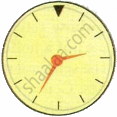
A ray of light strikes a plane mirror PQ at an angle of incidence of 30°, is reflected from the plane mirror and then strikes a second plane mirror QR placed at right angles to the first mirror. The angle of reflection at the second mirror is ______.
If a ray of light goes from a rarer medium to a denser medium, will it bend towards the normal or away from it?
Light travels more quickly through water than through glass.
If a ray of light passes from glass into water, which way will it bend : towards the normal or away from the normal?
How does the light have to enter the glass:
to produce a large amount of bending?
What do you understand by refraction of light?
The diagram (figure) given below shows two parallel rays 1 and 2 incident on (a) a concave mirror, (b) a convex mirror. Draw the reflected rays and mark the focus by the symbol F.
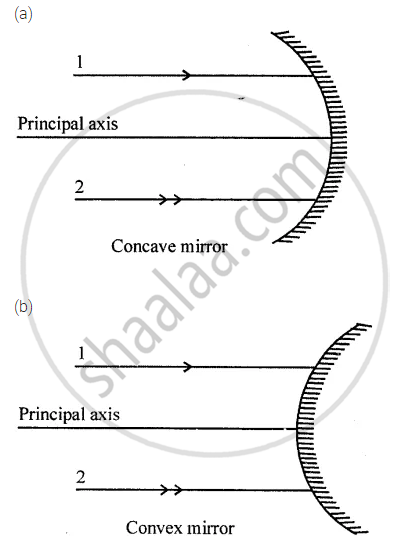
List four characteristics of the image formed by a concave lens of focal length 20 cm when the object is placed at a distance of 40 cm from its optical centre.
Light changes its direction when going from one transparent medium to another transparent medium. This is called _______.
Assertion and reasoning type
- Assertion: If the refractive index of the medium is high (denser medium) the velocity of the light in that medium will be small
- Reason: Refractive index of the medium is inversely proportional to the velocity of the light
The deviation of light ray from its path when it travels from one transparent medium to another transparent medium is called ______.
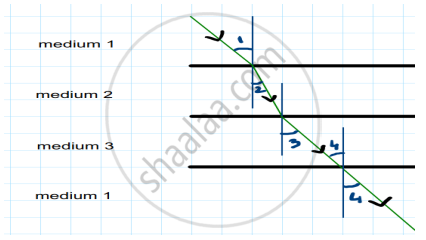
In the above diagram light is travelling through different media. It is noted by a scientist that ∠1= ∠3 = ∠4 but ∠2 < ∠1. Which of the following statement would be correct?
When light passes from one medium to another the ray gets bent. This property of light is called ______.
The bending of light as it passes from one medium to another is called ______.
Assertion: The air bubble shines in water.
Reason: Air bubble shines due to the refraction of light.
When light travels from a rarer medium to a denser medium, its speed:
When a ray of light is incident along the normal on the surface separating two media:
According to the second law of refraction, for a given pair of media, the ratio of the sine of the angle of incidence to the sine of the angle of refraction:
In the formula for absolute refractive index \[n = \frac{c}{v}\], the quantity c represents:
