Advertisements
Advertisements
प्रश्न
An object is placed 20 cm in front of a plane mirror. The mirror is moved 2 cm towards the object. The distance between the positions of the positions of the original and final images seen in the mirror is ______.
विकल्प
2 cm
4 cm
10 cm
22 cm
Advertisements
उत्तर
An object is placed 20 cm in front of a plane mirror. The mirror is moved 2 cm towards the object. The distance between the positions of the positions of the original and final images seen in the mirror is 4 cm.
APPEARS IN
संबंधित प्रश्न
The angle of reflection is equal to the angle of incidence:
(a) always
(b) sometimes
(c) under special conditions
(d) never
The image formed by a plane mirror is :
(a) virtual, behind the mirror and enlarged.
(b) virtual, behind the mirror and of the same size as the object.
(c) real, at the surface of the mirror and enlarged.
(d) real, behind the mirror and of the same size as the object.
State two effects caused by the refraction of light.
Show the lateral displacement of the ray on the diagram.
How does the light have to enter the glass:
to produce a large amount of bending?
A ray of light A incident from air suffers partial reflection and refraction at the boundary of water.
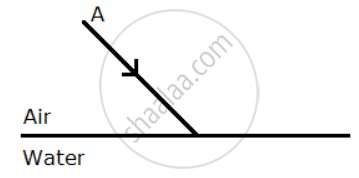
- Complete the diagram showing (i) the reflected ray B and (ii) the refracted ray C.
- How are the angles of incidence i and refraction r related?
Fill in the blank and Explain the completed sentences.
The change in ______ of light rays while going from one medium to another is called refraction.
List four characteristics of the image formed by a concave lens of focal length 20 cm when the object is placed at a distance of 40 cm from its optical centre.
A real image is formed by the light rays after reflection or refraction when they:
- actually meet or intersect with each other.
- actually converge at a point.
- appear to meet when they are produced in the backward direction.
- appear to diverge from a point.
Which of the above statements are correct?
Write scientific reason.
A pencil appears to be broken near the surface of water.
Explain the working of a periscope.
State whether true or false. If false, correct the statement.
The angle of deviation depends on the refractive index of the glass.
Which is optically denser out of the two medium M1& M2 having the refractive indices = 1.71 and 1.36 respectively?
The ray that enters the second medium after crossing the boundary is called the:
A normal is an imaginary line drawn ________ to the boundary at the point of incidence.
When a light ray passes from a rarer medium to a denser medium, it bends:
When light travels from a rarer medium to a denser medium, its speed:
When a ray of light is incident along the normal on the surface separating two media:
Which of the following relations is called Snell's Law?
