Advertisements
Advertisements
प्रश्न
What happens when a ray of light falls normally (or perpendiculary) on the surface of a plane mirror?
Advertisements
उत्तर
When a ray of light falls normally (or perpendicularly) on the surface of a plane mirror, it gets reflected along the same path because the angles of incidence and reflection are both equal to zero.
APPEARS IN
संबंधित प्रश्न
A ray of light is incident normally on a plane mirror. What will be the:
- angle of incidence?
- angle of reflection?
State the kind of mirror used
(a) by a dentist, and
(b) as a street light reflector.
The letters on the front of an ambulance are written laterally inverted like  . Give reason.
Name the spherical mirror which (i) diverges (ii) converges the beam of light incident on it. Justify your answer by drawing a ray diagram in each case.
Write the spherical mirror's formula and explain the meaning of each symbol used in it.
Which mirror will you prefer to use as a rear view mirror in a car : plane mirror or convex mirror? Give one reason.
The image formed by a convex mirror is
An object of length 4 cm is placed in front of a concave mirror at distance 30 cm. The focal length of mirror is 15 cm.
- Where will the image form?
- What will be the length of image?
Answer the following question:
Distinguish between the convex mirror and the concave mirror.
Select the correct option:
A concave mirror is made by cutting a portion of a hollow glass sphere of radius 30 cm. The focal length of the concave mirror is:
Define the following term:
spherical mirror
What do you understand by the term real image?
Define linear magnification produced by a mirror?
Define the term Focus of a concave mirror.
A concave mirror can be used to produce a parallel beam of light. Draw a ray to illustrate this.
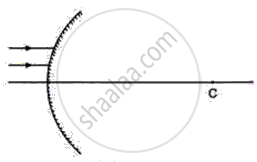
The diagram below shows the parallel rays incident on a convex mirror. C is the centre of the curvature of the mirror. By drawing the paths of the reflected rays, label the focus F and hence find the focal length of the mirror.
The spherical mirror used as a rear view mirror in the vehicle is
In torches, search lights and headlights of vehicles the bulb is placed ______.
Name the type of mirror used in the following situation:
Solar furnace
Support your answer with reason.
