Advertisements
Advertisements
Question
What happens when a ray of light falls normally (or perpendiculary) on the surface of a plane mirror?
Advertisements
Solution
When a ray of light falls normally (or perpendicularly) on the surface of a plane mirror, it gets reflected along the same path because the angles of incidence and reflection are both equal to zero.
APPEARS IN
RELATED QUESTIONS
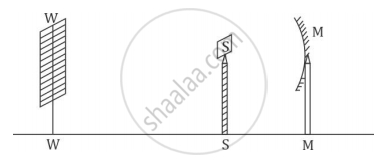
A student obtains a sharp image of the distant window (W) of the school laboratory on the screen (S) using the given concave mirror (M) to determine its focal length. Which of the following distances should he measure to get the focal length of the mirror?
Explain the following term related to spherical lenses:- principal axis
A ray of light strikes a plane mirror at an angle of 40° to the mirror surface. What will be the angle of reflection?
A ray of light travels from a denser medium to a rarer medium. How will it bend?
What is a spherical mirror?
State the two convenient rays that are chosen to construct the image by a spherical mirror for a given object? Explain your answer with the help of suitable ray diagrams.
Why does a driver use a convex mirror instead of a plane mirror as a rear view mirror?
Illustrate your answer with the help of a ray diagram.
For an incident ray directed towards centre of curvature of a spherical mirror the reflected ray:
A concave mirror forms a virtual image of size twice that of the object placed at a distance 5 cm from it. Find:
- the focal length of the mirror
- position of image
A straight stick partly dipped in water obliquely appears to be bent at the surface of the water.
Answer the following question:
Distinguish between the convex mirror and the concave mirror.
Define the following term:
convex mirror
Define the following term in relation to concave mirror.
Principal axis
Define the following term in relation to concave mirror.
Focal length
Define the term Normal.
The spherical mirror used in a beauty parlour as make-up mirror is _______.
In torches, search lights and headlights of vehicles the bulb is placed ______.
