Advertisements
Advertisements
Question
A ray of light is incident on a plane mirror at an angle of 30°. What is the angle of reflection
Advertisements
Solution
The angle of reflection is 30⁰ as the angle of incidence is equal to the angle of reflection, in accordance with the first law of reflection.
APPEARS IN
RELATED QUESTIONS
A simple microscope is used by watch repairers. Give reason.
A student focused the Sun rays using an optical device 'X' on a screen S as shown.
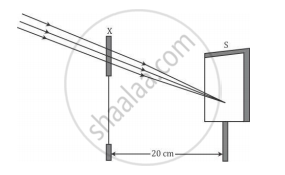
From this it may be concluded that the device 'X' is a (select the correct option)
(A) Convex lens of focal length 10 cm.
(B) Convex lens of radius of curvature 20 cm.
(C) Convex lens of focal length 20 cm.
(D) Concave mirror of focal length 20 cm.
Define the following term in the context of spherical mirrors:- Principal axis
Explain the following term related to spherical lenses: focal length
What type of image is formed:
- in a plane mirror?
- on a cinema screen?
Name the spherical mirror which can produce a virtual and diminished image of an object.
Explain the following term:
Incident ray
Draw diagram/diagrams to show them.
Name the mirror which always produces an erect and virtual image. How is the size of image related to the size of object?
The radius of curvature of a convex mirror is 40 cm. Find its focal length.
A point light source is kept in front of a convex mirror at a distance of 40 cm. The focal length of the mirror is 40 cm. Find the position of image.
The sun is seen before the sunrise and after the sunset.
Choose the correct alternative and rewrite the following:
Mirror used by a dental surgeon is ..........................
Select the correct option:
Which mirror is used in periscope?
Define the term Normal.
Draw a ray diagram to show that a convex mirror has a wider field of view.
If the focal length of a spherical mirror is 10 cm, what is the value of its radius of curvature?
Define focal length.
In torches, search lights and headlights of vehicles the bulb is placed ______.
Name the type of mirror used in the following situation:
Solar furnace
Support your answer with reason.
