Advertisements
Advertisements
Question
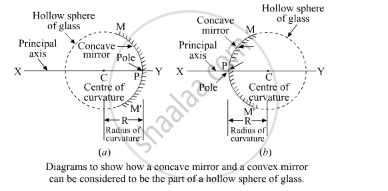
Define (a) centre of curvature (b) radius of curvature (c) pole (d) principal axis, and (e) aperture, of a spherical mirror with the help of a labelled diagram
Advertisements
Solution
(a) Centre of curvature (C) – It is the centre of the sphere from which the mirror is formed.
(b) Radius of curvature (R) – It is the radius of the sphere from which the mirror is formed.
R = PC
(c) Pole (P) – Pole is the centre of the curved mirror surface, MM’.
(d) Principal axis – It is the line joining P and C.
(e) Aperture – It is the effective length of the mirror, i.e. MM’.
APPEARS IN
RELATED QUESTIONS
Explain the following term related to spherical lenses:- aperture
A concave mirror always forms a real image.
What type of image is formed:
- in a plane mirror?
- on a cinema screen?
What type of image is formed:
on a cinema screen?
The shiny outer surface of a hollow sphere of aluminium of radius 50 cm is to be used as a mirror:
What will be the focal length of this mirror?
What do you mean by the term dispersion?
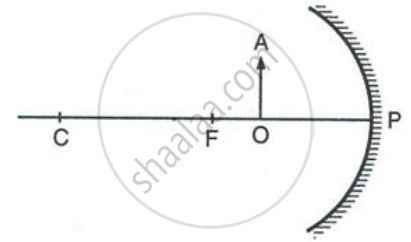
Figure shows a concave mirror with its pole at P, focus F and centre of curvature C. Draw ray diagram to show the formation of image of an object OA.
Name the kind of mirror used to obtain :
A real and enlarged image
A real and enlarged image can be obtained by using a
An object is placed at 4 cm distance in front of a concave mirror of radius of curvature 24 cm. Find the position of image. Is the image magnified?
Define the following term:
concave mirror
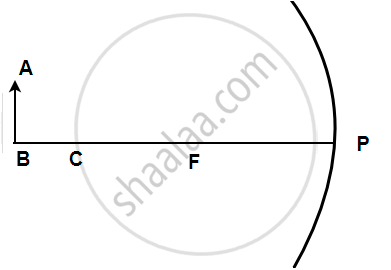
The following figure shows a concave mirror with its pole (P), focus (F), and center of curvature (C). Draw a ray diagram to show the formation of the image of an object AB by the concave mirror.
Complete the following diagrams shown in the below figure by drawing the reflected ray for each incident ray.
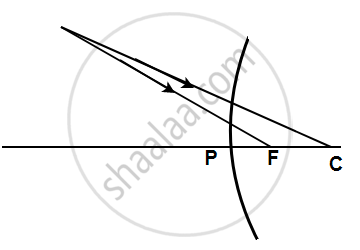
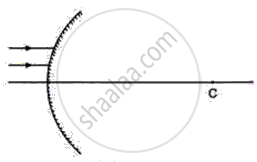
The diagram below shows the parallel rays incident on a convex mirror. C is the centre of the curvature of the mirror. By drawing the paths of the reflected rays, label the focus F and hence find the focal length of the mirror.
The spherical mirror used in a beauty parlour as make-up mirror is _______.
