Advertisements
Advertisements
प्रश्न
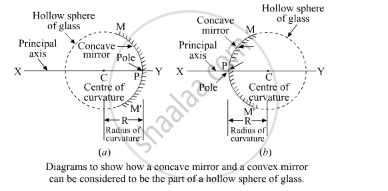
Define (a) centre of curvature (b) radius of curvature (c) pole (d) principal axis, and (e) aperture, of a spherical mirror with the help of a labelled diagram
Advertisements
उत्तर
(a) Centre of curvature (C) – It is the centre of the sphere from which the mirror is formed.
(b) Radius of curvature (R) – It is the radius of the sphere from which the mirror is formed.
R = PC
(c) Pole (P) – Pole is the centre of the curved mirror surface, MM’.
(d) Principal axis – It is the line joining P and C.
(e) Aperture – It is the effective length of the mirror, i.e. MM’.
APPEARS IN
संबंधित प्रश्न
Define the following term in the context of spherical mirrors:- Principal focus
Explain the following term related to spherical lenses:- aperture
Give one use each of a concave and a convex mirror.
A ray of light is incident normally on a plane mirror. What will be the:
- angle of incidence?
- angle of reflection?
A ray of light is incident normally on a plane mirror. What will be the
angle of reflection?
Name the spherical mirror which has:
(a) virtual principal focus.
(b) real principal focus.
What is the relation between the focal length and radius of curvature of a spherical mirror (concave mirror or convex mirror)?
Name the kind of mirror used to obtain :
A real and enlarged image
Upto what maximum distance from the pole the image in a convex mirror can be obtained? what will be the location of object then ?
The image formed by a convex mirror is
An object of height 2 cm is placed at a distance of 20 cm in front of a concave mirror of a focal length of 12 cm. Find the position, size, and nature of the image.
Select the correct option:
A mirror forms a virtual image (diminished) of an object, whatever be the position of object:
Select the correct option:
Which mirror is used in periscope?
Define the term Principle focus.
A concave mirror can be used to produce a parallel beam of light. Draw a ray to illustrate this.
The spherical mirror with a reflecting surface curved inward is called
