Advertisements
Advertisements
प्रश्न
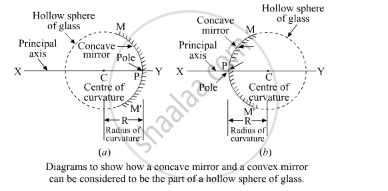
Define (a) centre of curvature (b) radius of curvature (c) pole (d) principal axis, and (e) aperture, of a spherical mirror with the help of a labelled diagram
Advertisements
उत्तर
(a) Centre of curvature (C) – It is the centre of the sphere from which the mirror is formed.
(b) Radius of curvature (R) – It is the radius of the sphere from which the mirror is formed.
R = PC
(c) Pole (P) – Pole is the centre of the curved mirror surface, MM’.
(d) Principal axis – It is the line joining P and C.
(e) Aperture – It is the effective length of the mirror, i.e. MM’.
APPEARS IN
संबंधित प्रश्न
Explain the following term related to spherical lenses:- aperture
We can obtain an enlarged and erect image by a convex mirror.
Define the Focal length of a spherical mirror
What happens when a ray of light falls normally (or perpendiculary) on the surface of a plane mirror?
Define the following terms in the context of spherical mirrors :
(i) Pole
(ii) Centre of curvature
(iii) Radius of curvature
(iv) Principal axis
Name the mirrors shown in Figure (a) and (b).
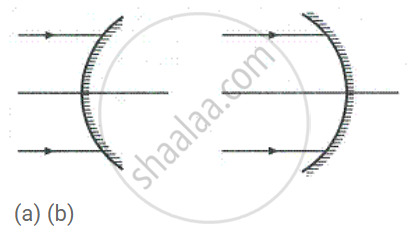
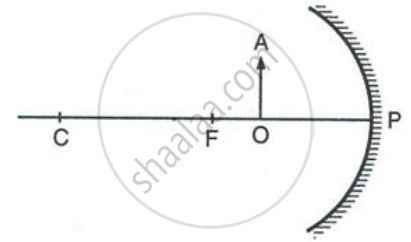
Figure shows a concave mirror with its pole at P, focus F and centre of curvature C. Draw ray diagram to show the formation of image of an object OA.
Draw a ray diagram to show the formation of image by a concave mirror for an object placed between its pole and focus. State three characteristics of the image.
Name the kind of mirror used to obtain:
A real and diminished image.
Which mirror will you prefer to use as a rear view mirror in a car : plane mirror or convex mirror? Give one reason.
Select the correct option:
Looking into a mirror one finds her image diminished, the mirror is:
Define the following term in relation to concave mirror.
Radius of curvature
If the focal length of a spherical mirror is 10 cm, what is the value of its radius of curvature?
Size of image of an object by a mirror having a focal length of 20 cm is observed to be reduced to 1/3rd of its size. At what distance the object has been placed from the mirror? What is the nature of the image and the mirror?
The minimum length of the mirror required to see the full image of the person is half ‘ of his height.
