Advertisements
Advertisements
Question
A ray of light strikes a plane mirror at an angle of 40° to the mirror surface. What will be the angle of reflection?
Advertisements
Solution
he angle of reflection is 500, in accordance with the first law of reflection, which states that the angle of incidence is equal to the angle of reflection.
Here, the angle of incidence = 90o - 40o = 50o( the angle of incidence is the angle between the incident ray and the normal).
APPEARS IN
RELATED QUESTIONS
Explain the following term related to spherical lenses:- optical centre
A student focused the Sun rays using an optical device 'X' on a screen S as shown.
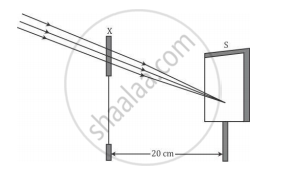
From this it may be concluded that the device 'X' is a (select the correct option)
(A) Convex lens of focal length 10 cm.
(B) Convex lens of radius of curvature 20 cm.
(C) Convex lens of focal length 20 cm.
(D) Concave mirror of focal length 20 cm.
Explain the following term related to spherical lenses:- principal focus
When a spherical mirror is held towards the sun and its sharp image is formed on a piece of a carbon paper for some time, a hole is burnt in the carbon paper.
Why is a hole burnt in the carbon paper?
Name the spherical mirror which can produce a virtual and diminished image of an object.
The shiny outer surface of a hollow sphere of aluminium of radius 50 cm is to be used as a mirror:
- What will be the focal length of this mirror?
- Which type of spherical mirror will it provide?
- State whether this spherical mirror will diverge or converge light rays.
A diverging lens is used in ______.
Draw a ray diagram to show the formation of image by a concave mirror for an object placed between its pole and focus. State three characteristics of the image.
Answer the following question.
Write the modification in the curvature of the eye lens which enables us to see the nearby objects clearly?
Define the following term:
concave mirror
Define the following term in relation to concave mirror.
Pole
The diagram below shows the parallel rays incident on a convex mirror. C is the centre of the curvature of the mirror. By drawing the paths of the reflected rays, label the focus F and hence find the focal length of the mirror.
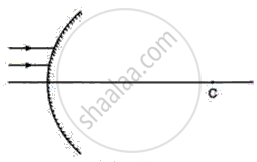
Explain why a ray of light passing through the center of curvature of a concave mirror, gets reflected along with the same pattern.
How tall does a mirror have to be to fit an entire person’s body?
What is “aperture”?
A converging lens of focal length f is placed at a distance 0.3 m from an object to produce an image on a screen 0.9 m from the lens. With the object and the screen in the same positions, an image of the object could also be produced on the screen by placing a converging lens of focal length.
Define the following terms in the context of a diverging mirror:
- Principal focus
- Focal length
Draw a labelled ray diagram to illustrate your answer.
