Advertisements
Advertisements
Question
A ray of light is incident normally on a plane mirror. What will be the:
- angle of incidence?
- angle of reflection?
Advertisements
Solution
- The angle of incidence is 0° because the incident ray is parallel to the normal.
- The angle of reflection is 0° in accordance with the first law of reflection, which states that the angle of incidence is equal to the angle of reflection.
APPEARS IN
RELATED QUESTIONS
A simple microscope is used by watch repairers. Give reason.
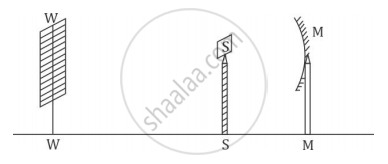
A student obtains a sharp image of the distant window (W) of the school laboratory on the screen (S) using the given concave mirror (M) to determine its focal length. Which of the following distances should he measure to get the focal length of the mirror?
We can obtain an enlarged and erect image by a convex mirror.
What type of image is formed:
on a cinema screen?
Name the two types of spherical mirrors. What type of mirror is represented by the:
front side of a shining steel spoon?
Complete the following sentence:
All the distances are measured from the .......... of a spherical mirror.
The shiny outer surface of a hollow sphere of aluminium of radius 50 cm is to be used as a mirror:
- What will be the focal length of this mirror?
- Which type of spherical mirror will it provide?
- State whether this spherical mirror will diverge or converge light rays.
- A small object is placed 150 mm away from a diverging lens of focal length 100 mm.
- Copy the figure below and draw rays to show how an image is formed by the lens.
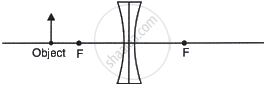
- Calculate the distance of the image from the lens by using the lens formula.
- Copy the figure below and draw rays to show how an image is formed by the lens.
- The diverging lens in part (a) is replaced by a converging lens also of focal length 100 mm. The object remains in the same position and an image is formed by the converging lens. Compare two properties of this image with those of the image formed by the diverging lens in part (a).
The diverging lens in part (a) is replaced by a converging lens also of focal length 100 mm. The object remains in the same position and an image is formed by the converging lens. Compare two properties of this image with those of the image formed by the diverging lens in part (a).
State the kind of mirror used
(a) by a dentist, and
(b) as a street light reflector.
State the position of object for which the image formed by a concave mirror is of same size.
Does the mirror mentioned in part (b) form real image for all locations of the object?
Draw a ray diagram to show the formation of image of an object kept in front of a convex mirror. State three characteristics of the image.
An object of height 2 cm is placed at a distance of 20 cm in front of a concave mirror of a focal length of 12 cm. Find the position, size, and nature of the image.
An object forms a virtual image which is 1/8th of the size of the object. If the object is placed at a distance of 40 cm from the convex mirror, calculate:
- the position of the image
- the focal length of the convex mirror.
Find the height of the image of a body of height 1.5m in a mirror with a magnification of 1.5.
In torches, search lights and headlights of vehicles the bulb is placed ______.
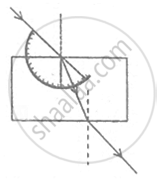
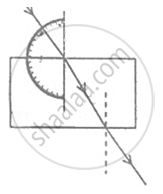
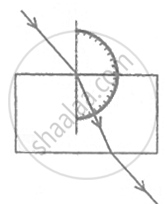
A student traces the path of a ray of light passing through a rectangular slab.
 |
 |
 |
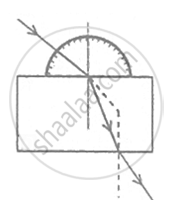 |
For measuring the angle of incidence, he must position the protractor in the manner shown in the figure:
