Advertisements
Advertisements
Question
The shiny outer surface of a hollow sphere of aluminium of radius 50 cm is to be used as a mirror:
- What will be the focal length of this mirror?
- Which type of spherical mirror will it provide?
- State whether this spherical mirror will diverge or converge light rays.
Advertisements
Solution
a. Given: Radius (r) = 50 cm
f = `r/2`
f = `50/2`
f = 25 cm
b. The convex mirror is the spherical mirror provided by it.
c. It will diverge light rays.
APPEARS IN
RELATED QUESTIONS
One half of a convex lens of focal length 10 cm is covered with a black paper. Can such a lens produce an image of a complete object placed at a distance of 30 cm from the lens? Draw a ray diagram to justify your answer. A 4 cm tall object is placed perpendicular to its principal axis of a convex lens of focal length 20 cm. The distance of the object from the lens is 15 cm. Find the nature, position and the size of the image.
A ray of light strikes a plane mirror at an angle of 40° to the mirror surface. What will be the angle of reflection?
Write the mirror formula. Give the meaning of each symbol which occurs in it.
A 50 cm tall object is at a very large distance from a diverging lens. A virtual, erect and diminished image of the object is formed at a distance of 20 cm in front of the lens. How much is the focal length of the lens?
A concave lens produces an image 20 cm from the lens of an object placed 30 cm from the lens. The focal length of the lens is:
(a) 50 cm
(b) 40 cm
(c) 60 cm
(d) 30 cm
What do you understand by the focus and focal length of a spherical mirror? Show them on the separate diagrams for each of a concave mirror and a convex mirror.
Name the spherical mirror which (i) diverges (ii) converges the beam of light incident on it. Justify your answer by drawing a ray diagram in each case.
Which mirror will you prefer to use as a rear view mirror in a car : plane mirror or convex mirror? Give one reason.
The erect image formed by a concave mirror is of size double the size of object. How are u and v related?
A concave mirror forms a virtual image of size twice that of the object placed at a distance 5 cm from it. Find:
- the focal length of the mirror
- position of image
The sun is seen before the sunrise and after the sunset.
Draw a ray diagram to show the formation of the image, when the object is placed between optical centre and principal focus of a convex lens.
State the signs and values of magnifications in the above mentioned case.
Select the correct option:
Which mirror is used in periscope?
Is real image always inverted?
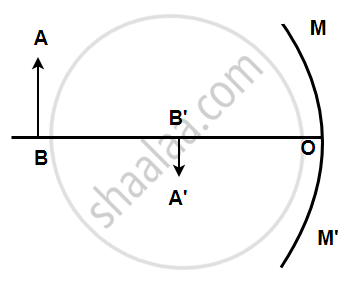
AB is the object, A'B' is the image, and MM' is the position of the mirror. Complete the ray diagram showing the formation of the image and find the focal length of the mirror.
The minimum length of the mirror required to see the full image of the person is half ‘ of his height.
The distance from the center of curvature of the mirror to the pole is called the focal length of the mirror.
