English

Draw a ray diagram to show the formation of the image, when the object is placed between optical centre and principal focus of a convex lens. - Science

Advertisements
Advertisements

Question

Draw a ray diagram to show the formation of the image, when the object is placed between optical centre and principal focus of a convex lens.

State the signs and values of magnifications in the above mentioned case.

Diagram
Short Answer
Advertisements

Solution

When an object is placed between the optical center and principal focus of a convex lens:
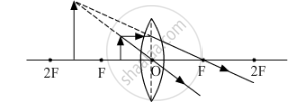
Since the image formed is virtual and erect, the sign of magnification will be positive. Moreover, the image formed is magnified; therefore, the absolute value of magnification will be greater than one.

shaalaa.com
  Is there an error in this question or solution?
2019-2020 (March) Delhi Set 1

Video TutorialsVIEW ALL [1]

RELATED QUESTIONS

A student focused the Sun rays using an optical device 'X' on a screen S as shown.

From this it may be concluded that the device 'X' is a (select the correct option)

(A) Convex lens of focal length 10 cm.

(B) Convex lens of radius of curvature 20 cm.

(C) Convex lens of focal length 20 cm.

(D) Concave mirror of focal length 20 cm.


Explain the following term related to spherical lenses:- principal axis


Name the two types of spherical mirrors. What type of mirror is represented by the:   

 back side of a shining steel spoon?


When a spherical mirror is held towards the sun and its sharp image is formed on a piece of a carbon paper for some time, a hole is burnt in the carbon paper. 

What name is given to the distance between spherical mirror and carbon paper?


A diverging lens is used in:
(a) a magnifying glass
(b) a car to see objects on rear side
(c) spectacles for the correction of short sight
(d) a simple camera


How is a spherical mirror used to diverge a beam of light from a point? Name the type of mirror used.


State the number of images of an object placed between two mirrors, formed in each case when mirrors are inclined to each other at (a) 90°, and (b) 60°.


Name the two kinds of spherical mirrors and distinguish between them. 


Discuss the position and nature of image formed by a concave mirror when an object is moved from infinity towards the pole of mirror. 


An object 5 cm in height is placed at a distance of 30 m in front of a concave mirror of focal length 40 cm. By scale, drawing finds the nature, size, position, and magnification of the image.

Share
Notifications

Englishहिंदीमराठी


      Forgot password?
Use app×