Advertisements
Advertisements
Question
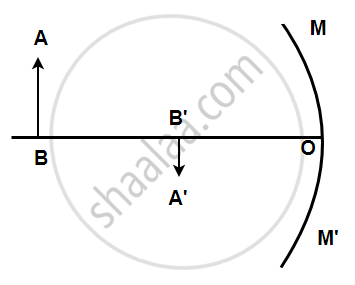
AB is the object, A'B' is the image, and MM' is the position of the mirror. Complete the ray diagram showing the formation of the image and find the focal length of the mirror.
Advertisements
Solution
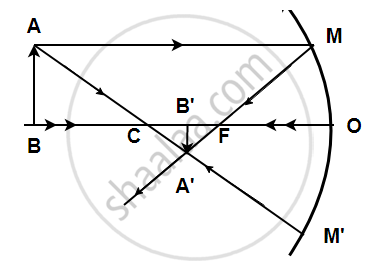
A light ray coming from a point on object AB is reflected from the surface of the mirror, it passes through the principal focus and the other ray passing through the center of curvature strikes the mirror normally i.e. 90 degrees. Hence it will reflect back. These two reflected rays coincide at a point where the image is formed. The image, A'B' is real, inverted, and diminished in size. The focal length was found to be 16 mm.
APPEARS IN
RELATED QUESTIONS
An image that cannot be obtained on a screen is called ______.
A ray of light travels from a denser medium to a rarer medium. How will it bend?
If a spherical mirror breaks, what type of mirrors are the individual pieces?
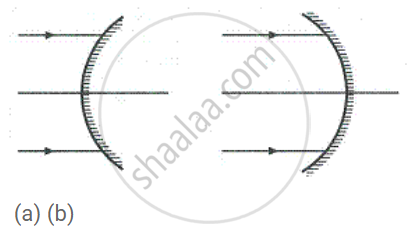
In each case (a) and (b), draw reflected rays for the given incident rays and mark focus by the symbol F.
The diagram below in Figure, shows a convex mirror. C is its centre of curvature and F is its focus. (i) Draw two rays from A and hence locate the position of image of object OA. Label the image IB. (ii) State three characteristics of the image.
Write two more characteristics of the image.
State the kind of mirror used
(a) By a dentist,
(b) As a search-light reflector.
In normal adjustment, for a refracting telescope, the distance between objective and eye piece is 30 cm. The focal length of the objective, when the angular magnification of the telescope is 2, will be ______.
