Advertisements
Advertisements
Question
Advertisements
Solution
APPEARS IN
RELATED QUESTIONS
When a spherical mirror is held towards the sun and its sharp image is formed on a piece of a carbon paper for some time, a hole is burnt in the carbon paper.
What is the advantage of using a carbon paper rather than a white paper?
How is the focal length of a spherical mirror related to its radius
Name the kind of mirror used to obtain
(a) a real and enlarged image
(b) a virtual and enlarged image
(c) a real and diminished image, and
(d) a virtual and diminished image.
State the types of mirrors used for (i) headlights and (ii) rear view mirror, in cars and motorcycles. Give to justify your answer in each case.
Three mirrors are created from a single sphere. Which of the following - pole, centre of curvature, radius of curvature, principal axis - will be common to them and which will not be common?

Does the mirror mentioned in part (b) form real image for all locations of the object?
Draw a ray diagram to show the formation of image of an object kept in front of a convex mirror. State three characteristics of the image.
Define the following term in relation to concave mirror.
Focal length
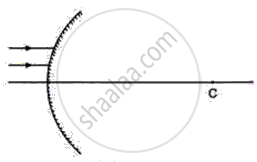
The diagram below shows the parallel rays incident on a convex mirror. C is the centre of the curvature of the mirror. By drawing the paths of the reflected rays, label the focus F and hence find the focal length of the mirror.
The spherical mirror used as a rear view mirror in the vehicle is
