Advertisements
Advertisements
Question
Advertisements
Solution
Height of object = 5 cm.
Distance of object = 30 cm.
Focal length of mirror = 40 cm.
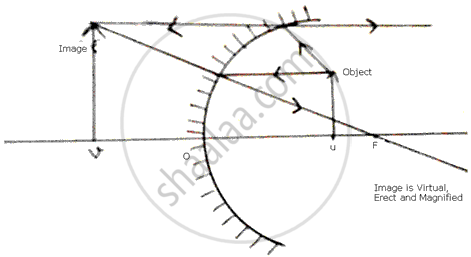
Image is virtual, erect, and magnified.
APPEARS IN
RELATED QUESTIONS
Explain the following term related to spherical lenses:- principal axis
What happens when a ray of light falls normally (or perpendiculary) on the surface of a plane mirror?
State the kind of mirror used
(a) by a dentist, and
(b) as a street light reflector.
State the two convenient rays that are chosen to construct the image by a spherical mirror for a given object? Explain your answer with the help of suitable ray diagrams.
Draw a ray diagram to show the formation of image by a concave mirror for the object beyond its centre of curvature. State three characteristics of the image.
The focal length of a concave mirror is 10 cm. Find its radius of curvature.
Define the term Principle focus.
The following Figure shows a concave mirror MM' on which a ray of light incident from a point P gets reflected to meet the principle axis at O.
(a) Find, by construction, the position of the centre of curvature of the concave mirror.
(b) Write down the value for the radius of curvature of the mirror.
(c) Calculate the focal length of the mirror.
(d ) Which relation is used in deducing the focal length from the radius of curvature?
If the real image of a candle flame formed by a lens is three times the size of the flame and the distance between lens and image is 80 cm, at what distance should the candle be placed from the lens?
In the figure shown, the image of a real object is formed at the point I. AB is the principal axis of the mirror. The mirror must be: