Advertisements
Advertisements
Question
State the number of images of an object placed between two mirrors, formed in each case when mirrors are inclined to each other at (a) 90°, and (b) 60°.
Advertisements
Solution
(a) Angle between the mirrors, θ = 90o
Now, n = 360o / θo = 360o / 90o = 4, which is even.
Hence number of images formed will be (n-1); i.e., 4 - 1 = 3 images
(b) Angle between the mirrors, θ = 60o
Now, n = 360o / θo = 360o / 60o = 6, which is even.
Hence number of images formed will be (n-1); i.e., 6-1 = 5 images
APPEARS IN
RELATED QUESTIONS
Explain the following term related to spherical lenses:- principal focus
Complete the following diagrams in Figure by drawing the reflected rays for the incident rays 1 and 2.
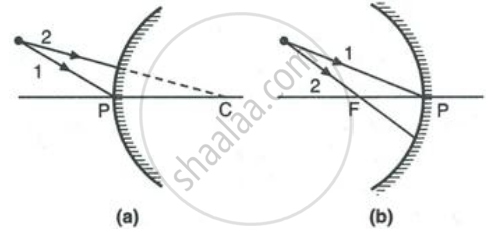
Does the mirror mentioned in part (b) form real image for all locations of the object?
A concave mirror forms a real image of an object placed in front of it at a distance 30 cm, of size three times the size of object. Find
- the focal length of mirror
- position of image.
A point light source is kept in front of a convex mirror at a distance of 40 cm. The focal length of the mirror is 40 cm. Find the position of image.
An object 5 cm high is placed at a distance 60 cm in front of a concave mirror of focal length 10 cm. Find the position and size of the image.
Define the following term in relation to concave mirror.
Radius of curvature
