Advertisements
Advertisements
Question
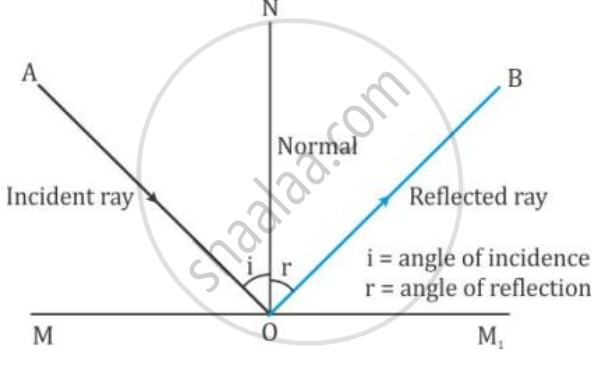
Explain the following term:
Incident ray
Draw diagram/diagrams to show them.
Advertisements
Solution
Incident ray: The light ray striking a reflecting surface is called the incident ray.
RELATED QUESTIONS
We can obtain a real, enlarged and inverted image by a concave mirror.
Complete the following sentence:
All the distances are measured from the .......... of a spherical mirror.
A diverging lens is used in ______.
State whether the image in part (a) is real or virtual?
Name the kind of mirror used to obtain :
A real and enlarged image
Name the kind of mirror used to obtain:
A real and diminished image.
Define the term Aperture.
Define the term Normal.
An object 10 cm high is placed at a distance of 20 cm in front of a spherical mirror of focal length 25 cm. By scale drawing find the nature, position, and magnification of the image in the following case:
Concave mirror
What is the difference between virtual images of an object formed by a concave mirror and a convex mirror?
