Advertisements
Advertisements
Question
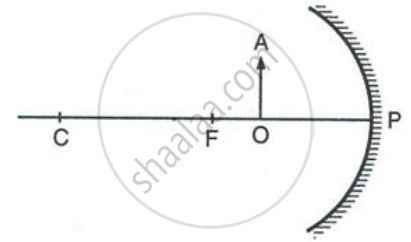
Figure shows a concave mirror with its pole at P, focus F and centre of curvature C. Draw ray diagram to show the formation of image of an object OA.
Advertisements
Solution

APPEARS IN
RELATED QUESTIONS
Define the following term in the context of spherical mirrors:- Centre of curvature
What kind of mirror is required for obtaining a virtual image of the same size as the object?
Name the two kinds of spherical mirrors and distinguish between them.
What type of mirror can be used to obtain a real image of an object?
A concave mirror forms a virtual image of size twice that of the object placed at a distance 5 cm from it. Find:
- the focal length of the mirror
- position of image
Select the correct option:
A concave mirror is made by cutting a portion of a hollow glass sphere of radius 30 cm. The focal length of the concave mirror is:
Define the following term in relation to concave mirror.
Radius of curvature
Define the following term in relation to concave mirror.
Aperture
Name the two types of spherical mirrors.
