Advertisements
Advertisements
Question
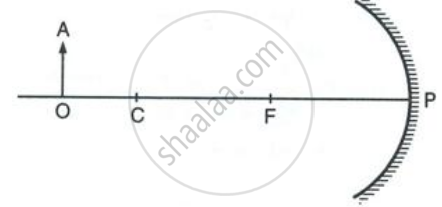
Figure shows a concave mirror with its pole at P, focus F and centre of curvature C. Draw ray diagram to show the formation of image of an object OA.
Advertisements
Solution

APPEARS IN
RELATED QUESTIONS
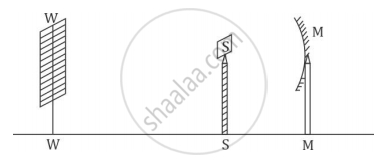
A student obtains a sharp image of the distant window (W) of the school laboratory on the screen (S) using the given concave mirror (M) to determine its focal length. Which of the following distances should he measure to get the focal length of the mirror?
The shiny outer surface of a hollow sphere of aluminium of radius 50 cm is to be used as a mirror:
- What will be the focal length of this mirror?
- Which type of spherical mirror will it provide?
- State whether this spherical mirror will diverge or converge light rays.
AB and CD, two spherical mirrors, from parts of a hollow spherical ball with its centre at O as shown in the diagram. If arc AB = `1/2` arc CD, what is the ratio of their focal lengths? State which of the two mirrors will always form virtual image of an object placed in front of it and why.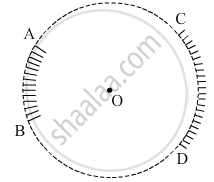
Name the kind of mirror used to obtain :
A real and enlarged image
Name the kind of mirror used to obtain:
A virtual and enlarged image
At what distance from a concave mirror of focal length 25 cm should an object be placed so that the size of image is equal to the size of the object.
Define the term Normal.
A concave mirror can be used to produce a parallel beam of light. Draw a ray to illustrate this.
The radius of curvature of a spherical mirror is 18 cm. What is the focal length of this mirror?
Explain why a ray of light passing through the center of curvature of a concave mirror, gets reflected along with the same pattern.
