Advertisements
Advertisements
Question
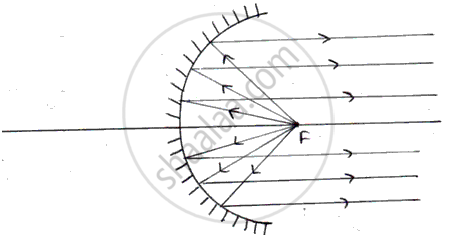
A concave mirror can be used to produce a parallel beam of light. Draw a ray to illustrate this.
Advertisements
Solution
In the case of a concave mirror if the object is placed at a Focal point then ray emerging from it after reflecting from the mirror would be parallel to the principal axis.
APPEARS IN
RELATED QUESTIONS
We can obtain a real, enlarged and inverted image by a concave mirror.
A concave mirror always forms a real image.
Match the items given in Column I with one or more items of Column II.
| Column I | Column II | ||
| (a) | A plane mirror | (i) | Used as a magnifying glass. |
| (b) | A convex mirror | (ii) | Can form image of objects spread over a large area. |
| (c) | A convex lens | (iii) | Used by dentists to see enlarged image of teeth. |
| (d) | A concave mirror | (iv) | The image is always inverted and magnified. |
| (e) | A concave lens | (v) | The image is erect and of the same size as the object. |
| (vi) | The image is erect and smaller in size than the object. |
Three mirrors are created from a single sphere. Which of the following - pole, centre of curvature, radius of curvature, principal axis - will be common to them and which will not be common?
State the two convenient rays that are chosen to construct the image by a spherical mirror for a given object? Explain your answer with the help of suitable ray diagrams.
Which of the following has curved reflecting surface?
The spherical mirror used in a beauty parlour as make-up mirror is _______.
