Advertisements
Advertisements
प्रश्न
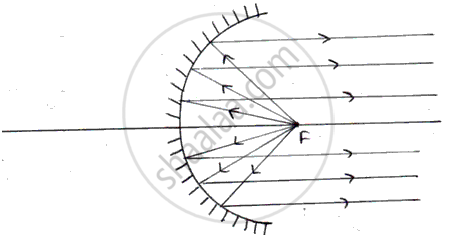
A concave mirror can be used to produce a parallel beam of light. Draw a ray to illustrate this.
Advertisements
उत्तर
In the case of a concave mirror if the object is placed at a Focal point then ray emerging from it after reflecting from the mirror would be parallel to the principal axis.
APPEARS IN
संबंधित प्रश्न
A simple microscope is used by watch repairers. Give reason.
A virtual image larger than the object can be produced by a ______.
Define the Focal length of a spherical mirror
When a spherical mirror is held towards the sun and its sharp image is formed on a piece of a carbon paper for some time, a hole is burnt in the carbon paper.
Why is a hole burnt in the carbon paper?
An object of length 4 cm is placed in front of a concave mirror at distance 30 cm. The focal length of mirror is 15 cm.
- Where will the image form?
- What will be the length of image?
Answer the following question.
Write the modification in the curvature of the eye lens which enables us to see the nearby objects clearly?
What is a mirror formula?
The radius of curvature of a spherical mirror is 18 cm. What is the focal length of this mirror?
Visit a nearby hospital. You can also visit the clinic of an ENT specialist, or a dentist. Request the doctor to show you the mirrors used for examining ear, nose, throat and teeth. Can you recognise the kind of mirror used in these instruments?
