Advertisements
Advertisements
प्रश्न
Name the spherical mirror which (i) diverges (ii) converges the beam of light incident on it. Justify your answer by drawing a ray diagram in each case.
Advertisements
उत्तर
(i) Convex mirror diverges a beam of light falling on it.
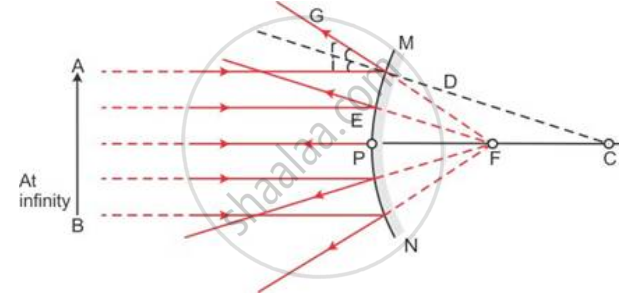
(ii) Concave mirror converges a beam of light falling on it.
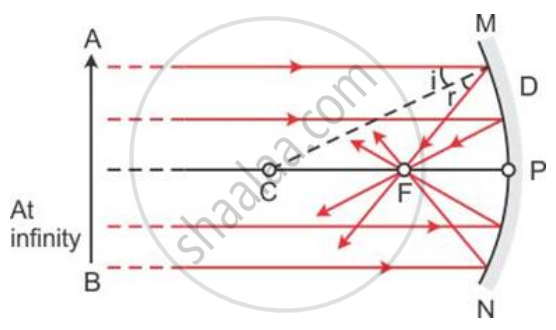
APPEARS IN
संबंधित प्रश्न
A student used a device (X) to obtain/focus the image of a well illuminated distant building on a screen (S) as shown below in the diagram. Select the correct statement about the device (X).
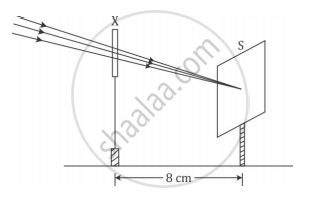
What is the relation between the focal length and radius of curvature of a spherical mirror (concave mirror or convex mirror)?
What is a spherical mirror?
At what distance from a concave mirror of focal length 25 cm should an object be placed so that the size of image is equal to the size of the object.
A straight stick partly dipped in water obliquely appears to be bent at the surface of the water.
In torches, search lights and headlights of vehicles the bulb is placed ______.
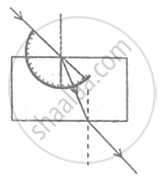
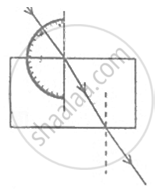
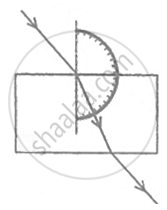
A student traces the path of a ray of light passing through a rectangular slab.
 |
 |
 |
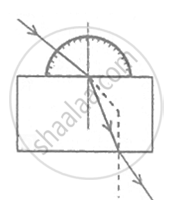 |
For measuring the angle of incidence, he must position the protractor in the manner shown in the figure:
What is the focal length (f) of a mirror?
