Advertisements
Advertisements
प्रश्न
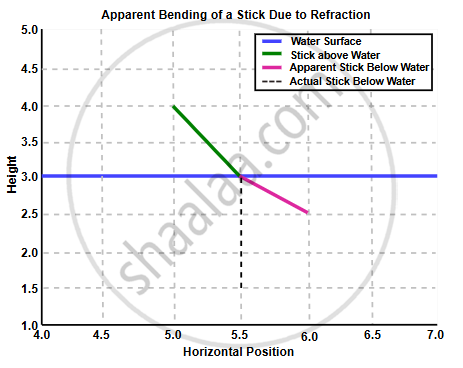
A straight stick partly dipped in water obliquely appears to be bent at the surface of the water.
A rod immersed partially and obliquely in water appears to be bent. Explain.
Advertisements
उत्तर १
The phenomenon is due to refraction of light.
A ray of light OC coming from O passes from water into air and is refracted away from normal (along CX). Another ray, OD, gets refracted along with DY. The two refracted rays CX and DY, when produced backwards, appear to meet at the point I. Thus, I is the virtual image of the end O of the stick. Therefore, the stick appears to be bent as shown below.

उत्तर २
- Light Refraction: When light passes from one medium (e.g., water) to another (e.g., air), it changes speed and direction. Light rays traveling from the submerged part of the stick (in water) to the observer's eyes (in air) bend away from normal at the water’s surface.
- Apparent Bending: Due to this bending of light, the part of the stick underwater appears shifted upward. As a result, the stick seems bent at the surface of the water, even though it is straight.
APPEARS IN
संबंधित प्रश्न
Explain the following term related to spherical lenses: focal length
- A small object is placed 150 mm away from a diverging lens of focal length 100 mm.
- Copy the figure below and draw rays to show how an image is formed by the lens.
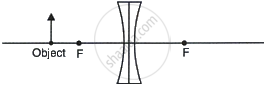
- Calculate the distance of the image from the lens by using the lens formula.
- Copy the figure below and draw rays to show how an image is formed by the lens.
- The diverging lens in part (a) is replaced by a converging lens also of focal length 100 mm. The object remains in the same position and an image is formed by the converging lens. Compare two properties of this image with those of the image formed by the diverging lens in part (a).
A concave lens produces an image 20 cm from the lens of an object placed 30 cm from the lens. The focal length of the lens is:
(a) 50 cm
(b) 40 cm
(c) 60 cm
(d) 30 cm
A coin placed at the bottom of a vessel appears to be raised when water is poured in the vessel.
What is a spherical mirror?
Draw a ray diagram to show the formation of image by a concave mirror for an object placed between its pole and focus. State three characteristics of the image.
State the position of object for which the image formed by a concave mirror is of same size.
Write the spherical mirror's formula and explain the meaning of each symbol used in it.
For an incident ray directed towards centre of curvature of a spherical mirror the reflected ray:
The radius of curvature of a convex mirror is 40 cm. Find its focal length.
An object 5 cm high forms a virtual image of 1.25 cm high, when placed in front of a convex mirror at a distance of 24 cm. Calculate:
- the position of the image
- the focal length of the convex mirror.
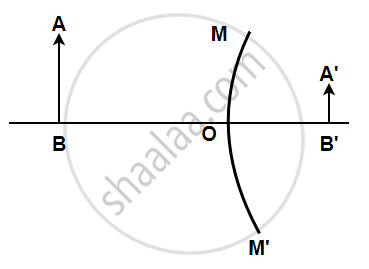
AB is the object, A1B1 is its image. MM' is the position of the mirror. Complete the ray diagram and find the position of the center of curvature and focus of the mirror. Also, measure the focal length.
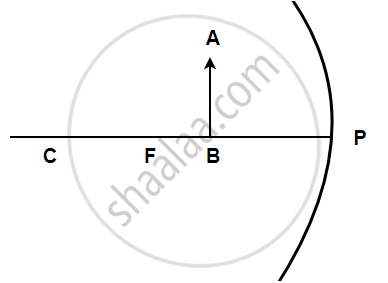
In the following figure shows a concave mirror with its pole (P), focus (F) and centre of curvature (C). Draw a ray diagram to show the formation of the image of an object AB by the concave mirror.
Define the term Principle focus.
The spherical mirror used as a rear view mirror in the vehicle is
In torches, search lights and headlights of vehicles the bulb is placed ______.
Visit a nearby hospital. You can also visit the clinic of an ENT specialist, or a dentist. Request the doctor to show you the mirrors used for examining ear, nose, throat and teeth. Can you recognise the kind of mirror used in these instruments?
