Advertisements
Advertisements
प्रश्न
Answer the following question:
Distinguish between the convex mirror and the concave mirror.
Advertisements
उत्तर
Convex mirror and concave mirror.
| Convex mirror | Concave mirror | |
| 1. | It is called a diverging mirror. | It is called a converging mirror. |
| 2. | The light is reflected from the outer surface. | The light is reflected from the inner surface. |
| 3. | It can form only a virtual image | It can form a real image as well as a virtual image. |
| 4. | According to sign convention, the focal length is positive. | According to sign convention, the focal length is negative. |
APPEARS IN
संबंधित प्रश्न
One half of a convex lens of focal length 10 cm is covered with a black paper. Can such a lens produce an image of a complete object placed at a distance of 30 cm from the lens? Draw a ray diagram to justify your answer. A 4 cm tall object is placed perpendicular to its principal axis of a convex lens of focal length 20 cm. The distance of the object from the lens is 15 cm. Find the nature, position and the size of the image.
A student used a device (X) to obtain/focus the image of a well illuminated distant building on a screen (S) as shown below in the diagram. Select the correct statement about the device (X).
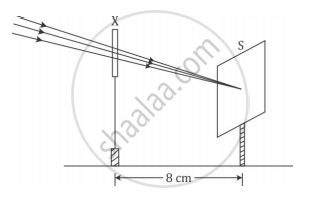
Define the following term in the context of spherical mirrors:- Principal axis
Define the following term in the context of spherical mirrors:- Principal focus
Match the items given in Column I with one or more items of Column II.
| Column I | Column II | ||
| (a) | A plane mirror | (i) | Used as a magnifying glass. |
| (b) | A convex mirror | (ii) | Can form image of objects spread over a large area. |
| (c) | A convex lens | (iii) | Used by dentists to see enlarged image of teeth. |
| (d) | A concave mirror | (iv) | The image is always inverted and magnified. |
| (e) | A concave lens | (v) | The image is erect and of the same size as the object. |
| (vi) | The image is erect and smaller in size than the object. |
A virtual image larger than the object can be produced by a ______.
What happens when a ray of light falls normally (or perpendiculary) on the surface of a plane mirror?
A ray of light is incident normally on a plane mirror. What will be the
angle of reflection?
What kind of mirror is required for obtaining a virtual image of the same size as the object?
What is the name of the phenomenon in which the right side of an object appears to be the left side of the image in a plane mirror?
Name the spherical mirror which has:
(a) virtual principal focus.
(b) real principal focus.
Name the two types of spherical mirrors. What type of mirror is represented by the:
- back side of a shining steel spoon?
- front side of a shining steel spoon?
When a spherical mirror is held towards the sun and its sharp image is formed on a piece of a carbon paper for some time, a hole is burnt in the carbon paper.
At which point of the spherical mirror the carbon paper is placed?
Name the spherical mirror which can produce a real and diminished image of an object.
The shiny outer surface of a hollow sphere of aluminium of radius 50 cm is to be used as a mirror:
Which type of spherical mirror will it provide?
A 2.0 cm tall object is placed 40 cm from a diverging lens of focal length 15 cm. Find the position and size of the image.
State the kind of mirror used
(a) by a dentist, and
(b) as a street light reflector.
State the types of mirrors used for (i) headlights and (ii) rear view mirror, in cars and motorcycles. Give to justify your answer in each case.
Define the terms focus and focal length of a concave mirror. Draw diagram to illustrate your answer.
State whether the image in part (a) is real or virtual?
Write two more characteristics of the image.
Which mirror will you prefer to use as a rear view mirror in a car : plane mirror or convex mirror? Give one reason.
An object 5 cm high is placed at a distance 60 cm in front of a concave mirror of focal length 10 cm. Find the position and size of the image.
A straight stick partly dipped in water obliquely appears to be bent at the surface of the water.
Draw a ray diagram to show the formation of the image, when the object is placed between optical centre and principal focus of a convex lens.
State the signs and values of magnifications in the above mentioned case.
An object 5 cm high forms a virtual image of 1.25 cm high, when placed in front of a convex mirror at a distance of 24 cm. Calculate:
- the position of the image
- the focal length of the convex mirror.
Define the following term in relation to concave mirror.
Aperture
Complete the following diagrams shown in the below figure by drawing the reflected ray for each incident ray.
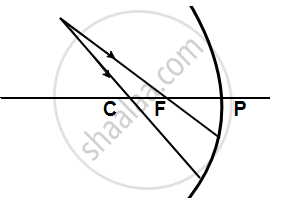
The distance from the pole to the focus is called ______.
Name the two types of spherical mirrors.
The image formed in a plane mirror is always inverted.
In normal adjustment, for a refracting telescope, the distance between objective and eye piece is 30 cm. The focal length of the objective, when the angular magnification of the telescope is 2, will be ______.
Visit a nearby hospital. You can also visit the clinic of an ENT specialist, or a dentist. Request the doctor to show you the mirrors used for examining ear, nose, throat and teeth. Can you recognise the kind of mirror used in these instruments?
