Advertisements
Advertisements
प्रश्न
Three mirrors are created from a single sphere. Which of the following - pole, centre of curvature, radius of curvature, principal axis - will be common to them and which will not be common?
Advertisements
उत्तर
Let us name the mirrors M1, M2 and M3 as shown below.
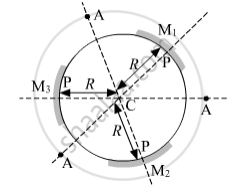
From the figure, we see that
- pole (P) is not common.
- centre of curvature (C) is common.
- principal axis (PA) is not common.
- radius of curvature (R) is common. The radius of curvature is the radius of the sphere. In the given figure, the length CP is the same for all mirrors.
APPEARS IN
संबंधित प्रश्न
A student obtains a sharp image of the distant window (W) of the school laboratory on the screen (S) using the given concave mirror (M) to determine its focal length. Which of the following distances should he measure to get the focal length of the mirror?
A student used a device (X) to obtain/focus the image of a well illuminated distant building on a screen (S) as shown below in the diagram. Select the correct statement about the device (X).
Define the following term in the context of spherical mirrors:- Pole
Define the following term in the context of spherical mirrors:- Principal focus
An image that cannot be obtained on a screen is called ______.
We can obtain a real, enlarged and inverted image by a concave mirror.
Which type of mirror can form a real image?
Write the formula for a lens connecting image distance (v), object distance (u) and the focal length (f). How does the lens formula differ from the mirror formula?
A coin placed at the bottom of a vessel appears to be raised when water is poured in the vessel.
Name the mirror which always produces an erect and virtual image. How is the size of image related to the size of object?
An object 5 cm high forms a virtual image of 1.25 cm high, when placed in front of a convex mirror at a distance of 24 cm. Calculate:
- the position of the image
- the focal length of the convex mirror.
Select the correct option:
A concave mirror is made by cutting a portion of a hollow glass sphere of radius 30 cm. The focal length of the concave mirror is:
Define the following term:
spherical mirror
Define the following term in relation to concave mirror.
Focal length
Find the height of the image of a body of height 1.5m in a mirror with a magnification of 1.5.
Define the term Principle focus.
The spherical mirror with a reflecting surface curved inward is called
