Advertisements
Advertisements
प्रश्न
Three mirrors are created from a single sphere. Which of the following - pole, centre of curvature, radius of curvature, principal axis - will be common to them and which will not be common?
Advertisements
उत्तर
Let us name the mirrors M1, M2 and M3 as shown below.
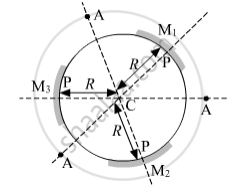
From the figure, we see that
- pole (P) is not common.
- centre of curvature (C) is common.
- principal axis (PA) is not common.
- radius of curvature (R) is common. The radius of curvature is the radius of the sphere. In the given figure, the length CP is the same for all mirrors.
APPEARS IN
संबंधित प्रश्न
Which type of mirror can form a real image?
The letter F is placed in front of a plane mirror:
What is the name of the phenomenon involved?
When a spherical mirror is held towards the sun and its sharp image is formed on a piece of a carbon paper for some time, a hole is burnt in the carbon paper.
What is the advantage of using a carbon paper rather than a white paper?
Write the mirror formula. Give the meaning of each symbol which occurs in it.
A 50 cm tall object is at a very large distance from a diverging lens. A virtual, erect and diminished image of the object is formed at a distance of 20 cm in front of the lens. How much is the focal length of the lens?
A ray of light travels from a denser medium to a rarer medium. How will it bend?
Define the terms pole, principal axis and centre of curvature with reference to a spherical mirror.
State the two convenient rays that are chosen to construct the image by a spherical mirror for a given object? Explain your answer with the help of suitable ray diagrams.
Draw a ray diagram to show the formation of image by a concave mirror for an object placed between its pole and focus. State three characteristics of the image.
State the position of object for which the image formed by a concave mirror is of same size.
Name the kind of mirror used to obtain:
A real and diminished image.
The image formed by a convex mirror is of size one third the size of object. How are u and v related?
An object of height 2 cm is placed at a distance of 20 cm in front of a concave mirror of a focal length of 12 cm. Find the position, size, and nature of the image.
Answer the following question.
Write the modification in the curvature of the eye lens which enables us to see the nearby objects clearly?
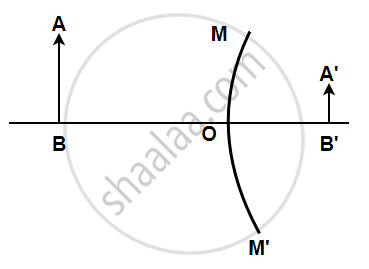
AB is the object, A1B1 is its image. MM' is the position of the mirror. Complete the ray diagram and find the position of the center of curvature and focus of the mirror. Also, measure the focal length.
An object 10 cm high is placed at a distance of 20 cm in front of a spherical mirror of focal length 25 cm. By scale drawing find the nature, position, and magnification of the image in the following case:
Convex mirror
The distance from the pole to the focus is called ______.
If the real image of a candle flame formed by a lens is three times the size of the flame and the distance between lens and image is 80 cm, at what distance should the candle be placed from the lens?
What is “aperture”?
In normal adjustment, for a refracting telescope, the distance between objective and eye piece is 30 cm. The focal length of the objective, when the angular magnification of the telescope is 2, will be ______.
