Advertisements
Advertisements
प्रश्न
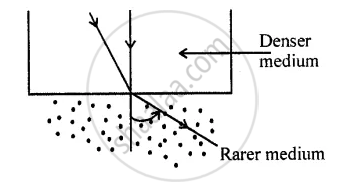
A ray of light travels from a denser medium to a rarer medium. How will it bend?
Advertisements
उत्तर
When a ray of light travels from a DENSER medium to a RARER medium it will bend AWAY from normal
.
APPEARS IN
संबंधित प्रश्न
What type of image is formed:
on a cinema screen?
A lens forms a real image 3 cm high of an object 1 cm high. If the separation of object and image is 15 cm, find the focal length of the lens.
A diverging lens is used in ______.
Discuss the position and nature of image formed by a concave mirror when an object is moved from infinity towards the pole of mirror.
A concave mirror forms a virtual image of size twice that of the object placed at a distance 5 cm from it. Find:
- the focal length of the mirror
- position of image
Define the following term in relation to concave mirror.
Principal axis
Define the following term in relation to concave mirror.
Radius of curvature
Define the following term in relation to concave mirror.
Aperture
