Advertisements
Advertisements
प्रश्न
Advertisements
उत्तर
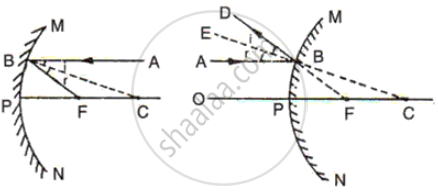
< i = < r
But < ABC = alternate< BCF
Therefore< CBF = < BCF
And the ΔFBC is isosceles
BF = FC ... (i)
PF = FC
PF + PF= PF + FC 2PF = PC
Now since PF = f, the focal length of the mirror
And PC = R, the radius of curvature of the mirror
From here we can determine the focal length of the concave mirror i.e. half of radius of curvature
APPEARS IN
संबंधित प्रश्न
When a spherical mirror is held towards the sun and its sharp image is formed on a piece of a carbon paper for some time, a hole is burnt in the carbon paper.
At which point of the spherical mirror the carbon paper is placed?
Explain the following terms :
Pole, Centre of curvature, Radius of curvature, Principal axis. Show them on separate diagrams for each of the concave and convex mirrors.
What do you understand by the focus and focal length of a spherical mirror? Show them on the separate diagrams for each of a concave mirror and a convex mirror.
State the kind of mirror used
(a) by a dentist, and
(b) as a street light reflector.
How is the focal length of a spherical mirror related to its radius of curvature?
Define the following term in relation to concave mirror.
Pole
Assertion: Incident ray is directed towards the centre of curvature of spherical mirror. After reflection it retraces its path.
Reason: Angle of incidence (i) = Angle of reflection (r) = 0°
Name the type of mirror used in the following situation:
Solar furnace
Support your answer with reason.
