Advertisements
Advertisements
Question
Advertisements
Solution
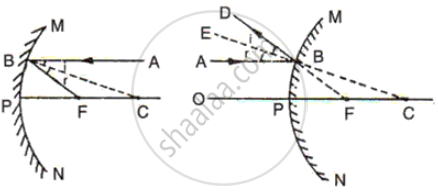
< i = < r
But < ABC = alternate< BCF
Therefore< CBF = < BCF
And the ΔFBC is isosceles
BF = FC ... (i)
PF = FC
PF + PF= PF + FC 2PF = PC
Now since PF = f, the focal length of the mirror
And PC = R, the radius of curvature of the mirror
From here we can determine the focal length of the concave mirror i.e. half of radius of curvature
APPEARS IN
RELATED QUESTIONS
An image formed by a ______ mirror is always of the same size as that of the object.
Name the two types of spherical mirrors. What type of mirror is represented by the:
front side of a shining steel spoon?
What is the relation between the focal length and radius of curvature of a spherical mirror (concave mirror or convex mirror)?
A lens forms a real image 3 cm high of an object 1 cm high. If the separation of object and image is 15 cm, find the focal length of the lens.
A 2.0 cm tall object is placed 40 cm from a diverging lens of focal length 15 cm. Find the position and size of the image.
Name the kind of mirror used to obtain :
A real and enlarged image
Select the correct option:
A concave mirror is made by cutting a portion of a hollow glass sphere of radius 30 cm. The focal length of the concave mirror is:
Which of the following has curved reflecting surface?
An object is placed at a distance of 0.25 m
in front of a plane mirror. The distance between the object and image will be ______.
