Advertisements
Advertisements
प्रश्न
Advertisements
उत्तर
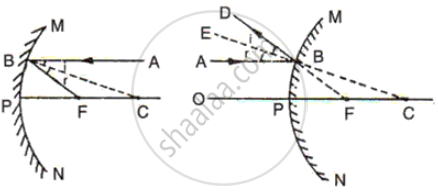
< i = < r
But < ABC = alternate< BCF
Therefore< CBF = < BCF
And the ΔFBC is isosceles
BF = FC ... (i)
PF = FC
PF + PF= PF + FC 2PF = PC
Now since PF = f, the focal length of the mirror
And PC = R, the radius of curvature of the mirror
From here we can determine the focal length of the concave mirror i.e. half of radius of curvature
APPEARS IN
संबंधित प्रश्न
Give one use each of a concave and a convex mirror.
Define the Focal length of a spherical mirror
State the two kinds of spherical mirror and distinguish them with the aid of proper diagrams.
How is a spherical mirror used to converge a beam of light at a point? Name the type of mirror used.
The letters on the front of an ambulance are written laterally inverted like  . Give reason.
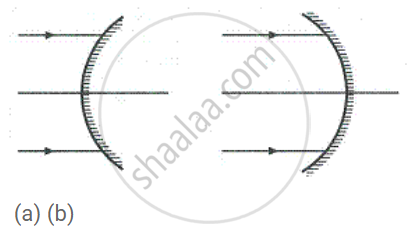
In each case (a) and (b), draw reflected rays for the given incident rays and mark focus by the symbol F.
Discuss the position and nature of image formed by a convex mirror when an object is moved from infinity towards the pole of mirror.
Define the term principal focus in case of convex mirror. Draw a convex mirror and show its principal focus and focal length clearly.
If the focal length of a spherical mirror is 10 cm, what is the value of its radius of curvature?
