Advertisements
Advertisements
प्रश्न
Name the spherical mirror which has:
(a) virtual principal focus.
(b) real principal focus.
Advertisements
उत्तर
The spherical mirror which has
(a) a virtual principal focus is a convex mirror
(b) a real principal focus is a concave mirror
APPEARS IN
संबंधित प्रश्न
One half of a convex lens of focal length 10 cm is covered with a black paper. Can such a lens produce an image of a complete object placed at a distance of 30 cm from the lens? Draw a ray diagram to justify your answer. A 4 cm tall object is placed perpendicular to its principal axis of a convex lens of focal length 20 cm. The distance of the object from the lens is 15 cm. Find the nature, position and the size of the image.
Explain the following term related to spherical lenses:- centres of curvature
Explain the following term related to spherical lenses: focal length
An image that cannot be obtained on a screen is called ______.
What type of image is formed:
on a cinema screen?
Name the two types of spherical mirrors. What type of mirror is represented by the:
- back side of a shining steel spoon?
- front side of a shining steel spoon?
Write the mirror formula. Give the meaning of each symbol which occurs in it.
Write the formula for a lens connecting image distance (v), object distance (u) and the focal length (f). How does the lens formula differ from the mirror formula?
A ray of light travels from a denser medium to a rarer medium. How will it bend?
A coin placed at the bottom of a vessel appears to be raised when water is poured in the vessel.
Which are the two convenient rays that are chosen to construct the image by a spherical mirror for a given object? Explain with the help of suitable ray diagrams.
Complete the following diagrams shown in Fig. by drawing the reflected ray for each of the incident ray A and B.
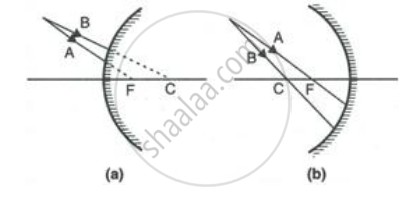
An object 5 cm high is placed at a distance 60 cm in front of a concave mirror of focal length 10 cm. Find the position and size of the image.
What do you understand by the term real image?
Complete the following diagrams shown in the following figures by drawing the reflected rays.
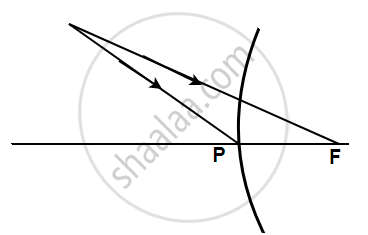
The diagram below shows the parallel rays incident on a convex mirror. C is the centre of the curvature of the mirror. By drawing the paths of the reflected rays, label the focus F and hence find the focal length of the mirror.
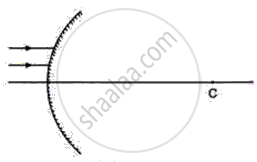
Define focal length.
If the real image of a candle flame formed by a lens is three times the size of the flame and the distance between lens and image is 80 cm, at what distance should the candle be placed from the lens?
Name the type of mirror used in the following situation:
Side/rear-view mirror of a vehicle
Support your answer with reason.
A spherical mirror whose reflecting surface is curved outwards is called ______ mirror.
