Advertisements
Advertisements
प्रश्न
Advertisements
उत्तर
APPEARS IN
संबंधित प्रश्न
State whether the image in part (a) is real or virtual?
The magnification for a mirror is -3. How are u and v related?
The erect image formed by a concave mirror is of size double the size of object. How are u and v related?
The image formed by a convex mirror is of size one third the size of object. How are u and v related?
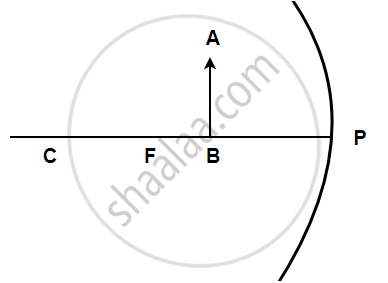
In the following figure shows a concave mirror with its pole (P), focus (F) and centre of curvature (C). Draw a ray diagram to show the formation of the image of an object AB by the concave mirror.
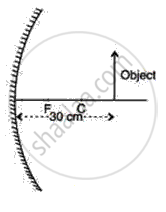
An object is placed in front of a concave mirror as shown in the following figure. By scale drawing, find the nature of the image. Given f = 10 cm, v = 30 cm.
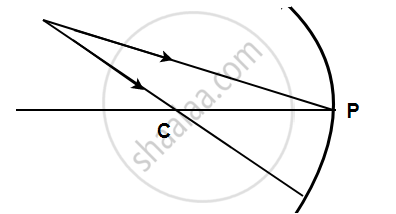
Complete the following diagrams shown in the following figures by drawing the reflected rays.
If the focal length of a spherical mirror is 10 cm, what is the value of its radius of curvature?
The minimum length of the mirror required to see the full image of the person is half ‘ of his height.
