Advertisements
Advertisements
प्रश्न
The image formed by a convex mirror is of size one third the size of object. How are u and v related?
Advertisements
उत्तर
Magnification is
m = `"I"/"O" = (1/3"O")/"O" = 1/3`
A convex mirror always forms a virtual and an upright image. So,
m = `-"v"/"u"`
∴ `-"v"/"u"` = `1/3`
∴ v = `-1/3"u"`
But , u is always negative
∴ v = `1/3"u"`
∴ u = 3v
APPEARS IN
संबंधित प्रश्न
A ray of light is incident normally on a plane mirror. What will be the
angle of reflection?
A coin placed at the bottom of a vessel appears to be raised when water is poured in the vessel.
State the two kinds of spherical mirror and distinguish them with the aid of proper diagrams.
Three mirrors are created from a single sphere. Which of the following - pole, centre of curvature, radius of curvature, principal axis - will be common to them and which will not be common?

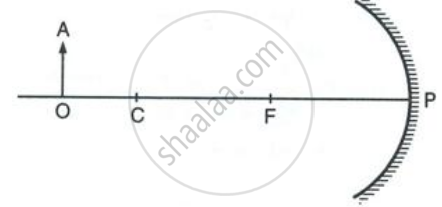
Figure shows a concave mirror with its pole at P, focus F and centre of curvature C. Draw ray diagram to show the formation of image of an object OA.
Name the kind of mirror used to obtain :
A real and enlarged image
State the kind of mirror used
(a) By a dentist,
(b) As a search-light reflector.
What is the difference between virtual images of an object formed by a concave mirror and a convex mirror?
